perfinr holds the tested, documented versions of the R functions in Personal Finance: a field manual. The book builds each calculation from scratch so you can see how the formula works. This package is for readers who want those same functions without copying code out of a chapter. It also suits anyone who wants small, transparent personal finance calculations in base R. The full documentation lives on the pkgdown site.
Installation
perfinr isn’t on CRAN. Install the development version from GitHub:
# install.packages("pak")
pak::pak("mjfrigaard/perfinr")
perfinr has no dependencies beyond base R.
Example
The book’s first job example takes home $3,200 a month and pays $960 in rent. The question is how much of that paycheck rent claims.
Think of take home pay as a single bar. Rent is one slice of it, and the rest of the bar is what’s left for everything else:
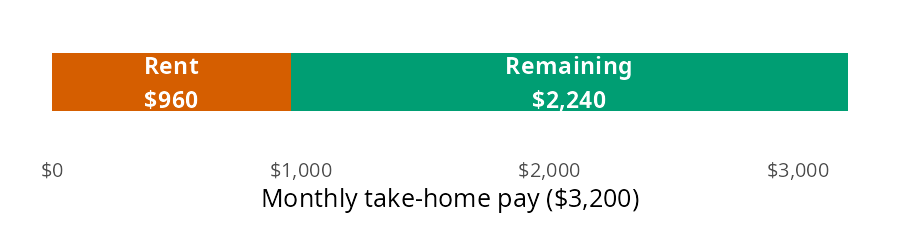
percent_of_income() divides the width of the slice by the width of the whole bar, then multiplies by 100:
library(perfinr)
rent_share <- percent_of_income(expense = 960, income = 3200)
rent_share
#> [1] 30
Rent takes 30% of take home pay.
One call, every category
Most functions are vectorized, so one call can compare several options. The code below passes every category from the book’s zero based budget to percent_of_income() at once:
budget <- data.frame(
  category = c("rent", "groceries", "transport", "investments", "savings", "fun money", "other"),
  amount = c(960, 350, 300, 320, 320, 450, 500)
)
budget$percent <- round(percent_of_income(expense = budget$amount, income = 3200), 1)
budget
#>      category amount percent
#> 1        rent    960    30.0
#> 2   groceries    350    10.9
#> 3   transport    300     9.4
#> 4 investments    320    10.0
#> 5     savings    320    10.0
#> 6   fun money    450    14.1
#> 7       other    500    15.6
Together the seven categories claim 100% of take home pay, so every dollar has a job.
Conventions
The functions keep the names, arguments, and defaults from the book, so code from a chapter runs unchanged after library(perfinr). A few rules hold across the whole package:
| Rule | Example |
|---|---|
| Rates and returns are decimals |
0.07 is 7% |
rule_of_72() is the exception and takes a percent |
rule_of_72(7) |
| Ratio functions return percents |
percent_of_income(960, 3200) returns 30, not 0.3 |
| Most functions are vectorized |
future_value(10000, 0.07, c(10, 20)) returns two values |
| A few functions take single values only |
income_tax(), raise_kept(), payoff_vs_invest(), first_payment_split()
|
| A 0% rate returns the no interest answer |
mortgage_payment(120000, 0, 30) is 120000 / 360
|
| Bad inputs stop early with an error | text, NA, or a zero where a divisor is needed |
Vignettes
The Get started vignette covers the conventions in more detail and takes a short tour of the book. Each chapter of the book also has its own vignette. It reuses the chapter’s numbers and bar models, then answers the same questions with perfinr functions. The chapter vignettes are grouped by book part.
Foundations:
The vignettes for the other four parts are still in progress.
Savings:
- Savings Strategies
- High-Yield Savings Accounts
- Automating Savings
Investing:
- Investing Basics
- Retirement Accounts
- Index Funds
- Asset Allocation
Taxes and insurance:
- Taxes
- Insurance
Planning:
- Financial Goals
- Major Purchases
- Estate Planning
Every function, its arguments, and its examples are listed in the function reference.