monthly = monthly_for_goal(goal=15000, annual_rate=0.04, months=60)
monthly226.2478308289896A goal without a number and a date is a wish. Once you have both, two questions are left: how much do you set aside each month, and which goal do you fund first when you can’t fund them all? In this page I’ll answer both with monthly_for_goal() and months_to_fund(), using the numbers from the Financial Goals chapter of the book so you can check every result.
Both functions accept arrays and follow the conventions on the Get started page.
| Function | Returns | Units |
|---|---|---|
| monthly_for_goal() | the monthly deposit that grows into a goal | dollars per month (annual_rate is a decimal) |
| months_to_fund() | months to save a goal with no interest | whole months, rounded up (an int) |
The chapter’s example is a $15,000 down payment in five years. The money sits in a high yield savings account earning 4% a year. Without interest you would divide $15,000 by 60 months and save $250 a month. Interest does part of the work, so you can save a little less.
The bar below is the $15,000 goal. Most of it comes from your deposits, and interest fills in the rest:
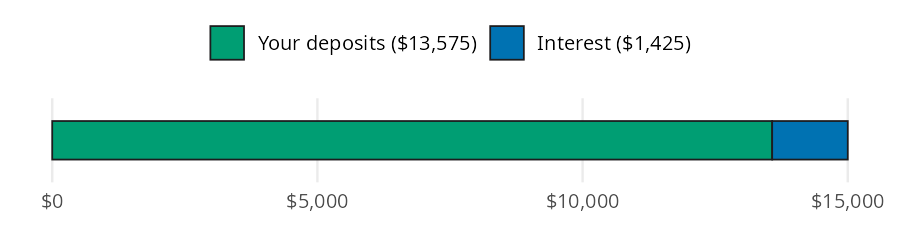
monthly_for_goal() works backward from the future value of a series of deposits. It asks which monthly deposit grows into the goal, compounding at annual_rate / 12:
monthly = monthly_for_goal(goal=15000, annual_rate=0.04, months=60)
monthly226.2478308289896You need about $226.25 a month, which is $23.75 less than saving without interest. Over five years your deposits total $13,575, and interest adds the other $1,425.
Say you can save $600 a month toward two goals: a $3,000 trip and a $9,000 car. You can fund them one at a time (trip first, then car), or split the $600 evenly until the trip is paid for and then send everything to the car.
Each bar below is a goal on a timeline. It starts at month 0 and ends the month the goal is fully funded:
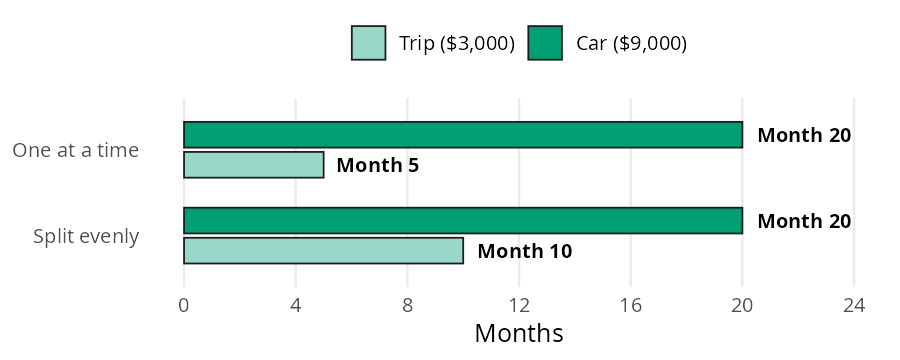
months_to_fund() divides the goal by the monthly amount going to it and rounds up to a whole month. The last goal is done when all of the money is saved, so its goal is the total of both:
one_at_a_time = (
    months_to_fund(goal=3000, monthly=600),
    months_to_fund(goal=3000 + 9000, monthly=600),
)
split_evenly = (
    months_to_fund(goal=3000, monthly=300),
    months_to_fund(goal=3000 + 9000, monthly=600),
)
one_at_a_time, split_evenly
((5, 20), (10, 20))The trip finishes at month 5 one at a time, or month 10 split evenly. The car finishes at month 20 either way. The order only decides which goal you get first.
Passing several rates to annual_rate shows how much interest helps the down payment goal. The 0% row is the plain $15,000 ÷ 60:
rates = [0.0, 0.02, 0.04, 0.05]
pl.DataFrame({
    "annual_rate": rates,
    "monthly": monthly_for_goal(goal=15000, annual_rate=rates, months=60),
})| annual_rate | monthly |
|---|---|
| f64 | f64 |
| 0.0 | 250.0 |
| 0.02 | 237.916401 |
| 0.04 | 226.247831 |
| 0.05 | 220.568505 |
Each point of interest trims the deposit by a few dollars a month. Time matters more. The same goal over three, five, and seven years:
months = [36, 60, 84]
pl.DataFrame({
    "months": months,
    "monthly": monthly_for_goal(goal=15000, annual_rate=0.04, months=months),
    "months_no_interest": months_to_fund(goal=15000, monthly=[400, 250, 180]),
})| months | monthly | months_no_interest |
|---|---|---|
| i64 | f64 | i64 |
| 36 | 392.859775 | 38 |
| 60 | 226.247831 | 60 |
| 84 | 155.032095 | 84 |
The last column runs the other direction: it asks how long $400, $250, or $180 a month takes with no interest at all.
monthly_for_goal() assumes the same rate every month and a deposit at the end of each month. It ignores taxes on interest and inflation, so a goal priced in today’s dollars will cost more later. months_to_fund() ignores interest entirely and rounds up, so it gives the first month the goal is fully funded.
Both functions stop with a ValueError when the divisor isn’t positive:
months_to_fund(goal=3000, monthly=0)--------------------------------------------------------------------------- ValueError Traceback (most recent call last) Cell In[6], line 1 ----> 1 months_to_fund(goal=3000, monthly=0) File ~/work/perfinpy/perfinpy/src/perfinpy/financial_goals.py:89, in months_to_fund(goal, monthly) 56 """Whole months to fund a goal with no interest. 57 58 From the [Financial Goals](https://mjfrigaard.github.io/fm-finance/financial_goals.html) (...) 86 (5, 20) 87 """ 88 goal = _as_numeric(goal, "goal") ---> 89 monthly = _as_positive(monthly, "monthly") 90 return _ceil(goal / monthly) File ~/work/perfinpy/perfinpy/src/perfinpy/_checks.py:38, in _as_positive(x, arg) 36 out = _as_numeric(x, arg) 37 if np.any(np.asarray(out) <= 0): ---> 38 raise ValueError(f"`{arg}` must be greater than 0.") 39 return out ValueError: `monthly` must be greater than 0.
monthly_for_goal() does the same when months is 0 or negative.
Back to the $600 a month. Suppose the down payment comes first, and whatever is left goes to the trip and the car. The down payment takes the amount we found above, and months_to_fund() shows how long the remainder needs for both smaller goals:
down_payment = monthly_for_goal(goal=15000, annual_rate=0.04, months=60)
left_over = 600 - down_payment
both_goals = months_to_fund(goal=3000 + 9000, monthly=left_over)
round(left_over, 2), both_goals
(373.75, 33)With $373.75 a month left over, the trip and the car take 33 months instead of 20. That trade is the real decision: the down payment stays on schedule, and the smaller goals wait longer. The Major Purchases page picks up the down payment and asks what the mortgage would cost.
A goal needs a number, a date, and a monthly amount. monthly_for_goal() turns the number and the date into the monthly amount, with interest doing part of the work. months_to_fund() shows that the order of your goals changes which one you reach first, but not when the last one is done.