A “goal” without a number and a date is a wish. This chapter is about turning wishes into plans you can actually follow: picking a number, picking a date, figuring out how much to set aside each month, and deciding what to do first when you can’t afford everything at once.
The earlier parts of this book gave you the pieces: a budget, an emergency fund, retirement accounts, and index funds. Goals are where you put those pieces to work on the things you actually want.
The first question for any goal is when you’ll need the money. That one answer decides where the money should live.
| Horizon | When you need it | Examples | Where to keep it |
|---|---|---|---|
| Short | Less than 3 years | A trip, a laptop, moving costs, a car repair fund | High yield savings account |
| Medium | 3 to 10 years | A car, a wedding, a house down payment | High yield savings, or a mix of bonds and stocks for the longer end |
| Long | More than 10 years | Retirement, financial independence | Index funds in retirement accounts |
The rule behind the table comes from Investing Basics: stocks can drop 30% or more in a bad year and take years to recover. Money you need soon can’t wait for a recovery, so it belongs in savings, even though it grows more slowly. Money you won’t touch for decades can ride out the drops, so it belongs in stocks.
“I want to buy a house someday” is a wish. “I want $15,000 for a down payment in five years” is a goal. The difference is that a goal tells you what to do this month.
Every goal needs three things:
Once you have the monthly amount, put it on autopilot. Give each goal its own savings account (many banks let you open several and name them), and set up an automatic transfer on payday, as described in Automating Savings. Watching a “Down Payment” account grow is far more motivating than one big pile of savings.
Ramit Sethi builds saving around specific goals. His Conscious Spending Plan sets aside 5% to 10% of take home pay for savings goals like a vacation, a wedding, or a down payment, separate from long term investing 1. Brian Preston’s Financial Order of Operations also gives planned future expenses their own step, after retirement saving is on track 2.
Morgan Housel argues the opposite: you don’t need a specific reason to save. Saving for a particular purchase makes sense in a predictable world, but the world isn’t predictable. Money saved without a goal gives you options and flexibility when something unexpected happens, good or bad 3.
What they agree on: saving more than you need for today is the foundation of everything else. Named goals make saving easier to stick with; savings without a goal give you room for the surprises no plan can predict. Most people do best with both.
Your goals compete for the same paycheck, so it helps to have an overall savings target. The experts give different numbers.
Ramit Sethi recommends about 10% of take home pay for investing and 5% to 10% for savings goals 4.
The Money Guy Show sets an aspirational target of 25% of gross income (your pay before taxes), and money saved in retirement accounts counts toward it. In your 20s and 30s, they say it’s fine to aim for a percentage and check later whether you’re on track 5.
The Retirement Accounts chapter used 15% for retirement as a common starting point.
What they agree on: the numbers aren’t as far apart as they look, since they’re measured from different starting points (take home vs. gross pay) and count different things. All of them say to start with what you can and increase it over time.
The practical answer for someone starting out: save what you can now, even if it’s 5%, and raise it by a percentage point or two every time you get a raise. Sethi suggests doing this every December 6.
Most people have more goals than money. The Financial Order of Operations handles the first priorities: cover your deductibles, get the employer match, pay off high interest debt, and build your emergency fund. Don’t skip those to save for a vacation. Every goal is easier with them in place.
After that, you have two ways to fund the rest:
One at a time gets you to your first goal sooner. All at once makes progress on everything, which helps if your goals have fixed dates (a wedding next summer, a car that’s about to die). As the math section shows, both approaches finish the last goal on the same day, so the choice is really about which goal you want first.
Checking your accounts every day doesn’t make them grow faster. It mostly makes you anxious, especially when investments drop. A simple rhythm works better:
Goals will change, and that’s fine. Housel’s warning is about the opposite problem: moving the goalposts every time you reach one, so that nothing ever feels like enough 7. When you hit a goal, take a moment to notice it before you set the next one.
The Emergency Fund chapter showed how to find the monthly amount for a goal with a deadline. Goal math adds two things: interest that helps you along the way, and choosing the order of several goals.
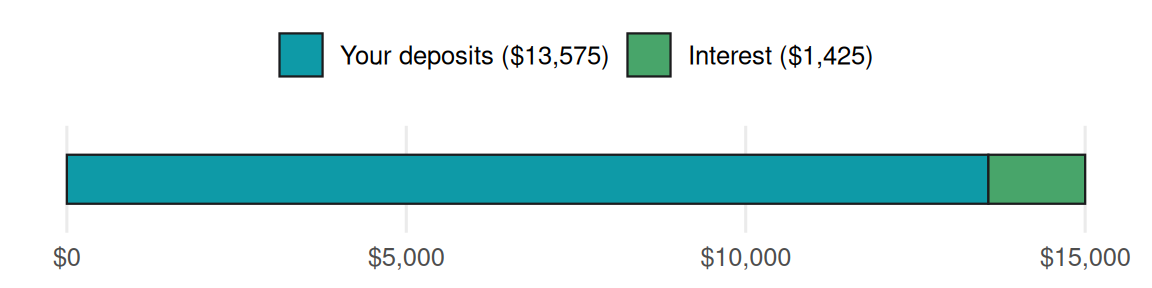
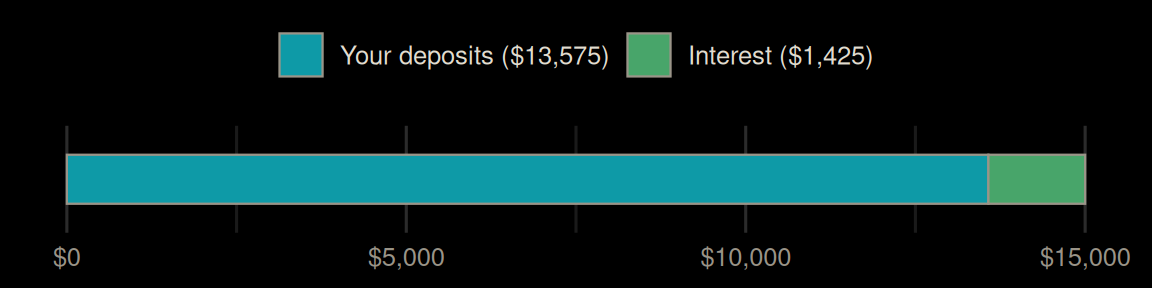
Imagine a $15,000 down payment in five years, saved in a high yield savings account earning 4%. Your monthly deposits build most of it, and interest fills in the rest. The bar below shows how the $15,000 splits between the two.
Without interest, you’d divide $15,000 by 60 months and save $250 a month. Interest does part of the work, so you can save a little less. The formula works backward from the future value formula in Investing Basics: instead of asking what a monthly deposit grows into, it asks what monthly deposit grows into your goal.
Formula: Monthly amount = Goal × r ÷ ((1 + r)^n − 1)
Example: $15,000 × 0.00333 ÷ ((1.00333)^60 − 1) = about $226 a month, $24 less than saving without interest. Over five years, interest adds about $1,425.
Check: your deposits come to about $226.25 × 60 = $13,575, and $13,575 + $1,425 of interest = $15,000, the goal.
Assuming the goal is in B2, the yearly rate is in C2, and the number of months is in D2:
=PMT(C2 / 12, D2, 0, -B2)def monthly_for_goal(goal, annual_rate, months):
r = annual_rate / 12
if r == 0:
return goal / months
return goal * r / ((1 + r) ** months - 1)
# $15,000 in 5 years at 4%, compared to no interest
print(monthly_for_goal(goal=15000, annual_rate=0.04, months=60))
#> 226.24783082898958
print(monthly_for_goal(goal=15000, annual_rate=0, months=60))
#> 250.0monthly_for_goal <- function(goal, annual_rate, months) {
r <- annual_rate / 12
if (r == 0) return(goal / months)
goal * r / ((1 + r)^months - 1)
}
# $15,000 in 5 years at 4%, compared to no interest
monthly_for_goal(goal = 15000, annual_rate = 0.04, months = 60)
#> [1] 226.2478
monthly_for_goal(goal = 15000, annual_rate = 0, months = 60)
#> [1] 250Say you can save $600 a month toward two goals: a $3,000 trip and a $9,000 car. Each bar below is a goal on a timeline, starting at month 0 and ending the month it’s fully funded. The top pair funds the trip first, then the car. The bottom pair splits the $600 evenly until the trip is paid for, then sends everything to the car.
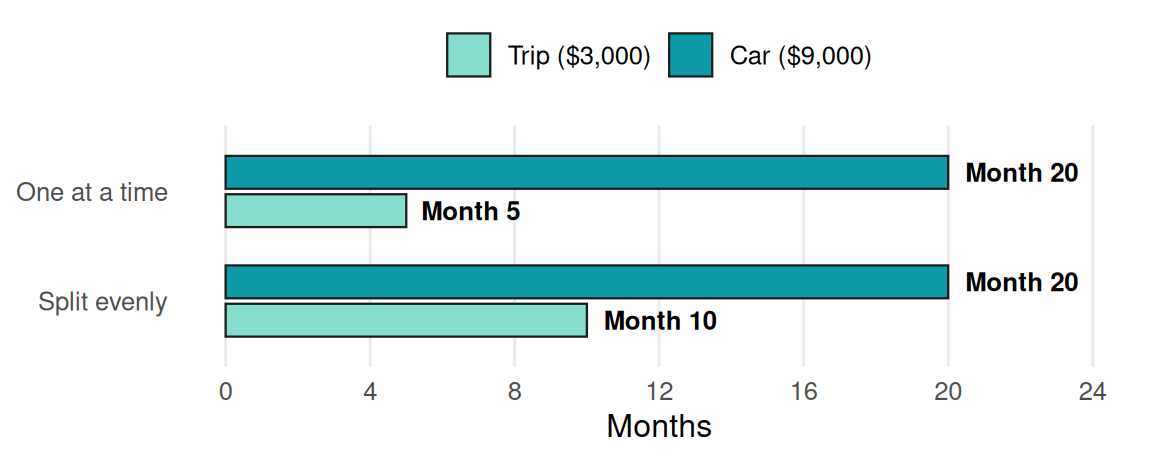
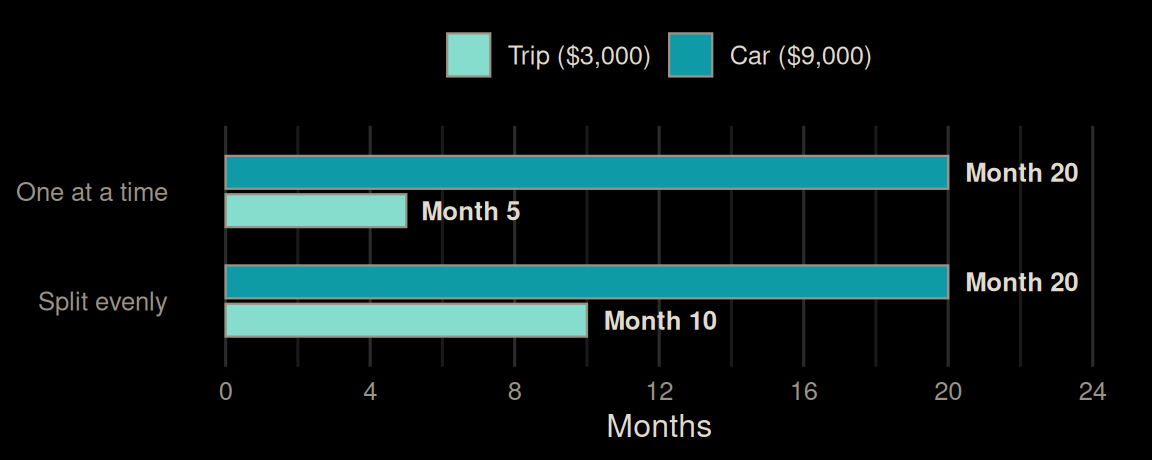
The trip finishes at month 5 or month 10, depending on the plan, but the car finishes at month 20 either way. That’s because the last goal is done when all of the money is saved, no matter what order it went in.
Formula: Months to finish all goals = Total of all goals ÷ Monthly savings, and Months to finish the first goal = First goal ÷ Amount going to it each month
Example: ($3,000 + $9,000) ÷ $600 = 20 months for both goals, either way. The trip takes $3,000 ÷ $600 = 5 months one at a time, or $3,000 ÷ $300 = 10 months split evenly.
Check: split evenly, the car has 10 × $300 = $3,000 when the trip is done, so the full $600 covers the last $6,000 in 10 more months, and 10 + 10 = 20.
Assuming the goal is in B2 and the monthly amount going to it is in C2:
=ROUNDUP(B2 / C2, 0)import math
def months_to_fund(goal, monthly):
return math.ceil(goal / monthly)
# one at a time: trip first, then car
print(months_to_fund(3000, 600), months_to_fund(3000 + 9000, 600))
#> 5 20
# split evenly: trip gets half until it's done
print(months_to_fund(3000, 300), months_to_fund(3000 + 9000, 600))
#> 10 20months_to_fund <- function(goal, monthly) {
ceiling(goal / monthly)
}
# one at a time: trip first, then car
months_to_fund(3000, 600)
#> [1] 5
months_to_fund(3000 + 9000, 600)
#> [1] 20
# split evenly: trip gets half until it's done
months_to_fund(3000, 300)
#> [1] 10
months_to_fund(3000 + 9000, 600)
#> [1] 20The next chapter takes the biggest goals most people ever save for, a car and a home, and walks through how to buy them without wrecking the rest of your plan.
I Will Teach You to Be Rich (2nd ed.). Sethi, Ramit. 2019.↩︎
The Financial Order of Operations. Preston, Brian. 2024.↩︎
The Psychology of Money: Timeless Lessons on Wealth, Greed, and Happiness. Housel, Morgan. 2020.↩︎
I Will Teach You to Be Rich (2nd ed.). Sethi, Ramit. 2019.↩︎
I’m Decades Away from Retirement: How Much Should I Invest?. May, Daniel. 2026.↩︎
I Will Teach You to Be Rich (2nd ed.). Sethi, Ramit. 2019.↩︎
The Psychology of Money: Timeless Lessons on Wealth, Greed, and Happiness. Housel, Morgan. 2020.↩︎