6 Savings Strategies
How much should you save? The honest answer is: as much as you can sustain. This chapter covers the principle that makes saving possible: automation through a simple formula that works with your budget, not against it. Most people fail at saving because they treat it as an afterthought—whatever’s left over at the end of the month. The path to financial independence reverses this: decide how much to save first, automate it, and let the rest be your budget.1
6.1 Savings Rate (the most important metric)
Ben Felix and John Bogle both stress this above all else.
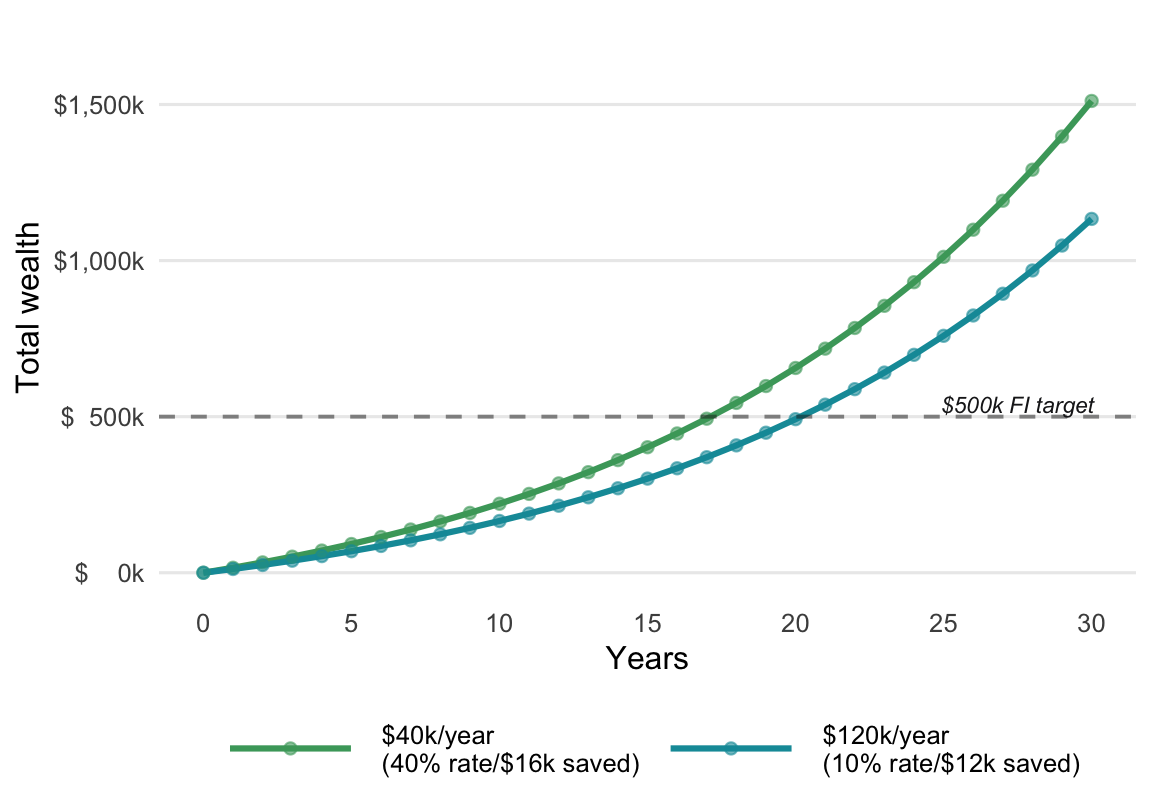
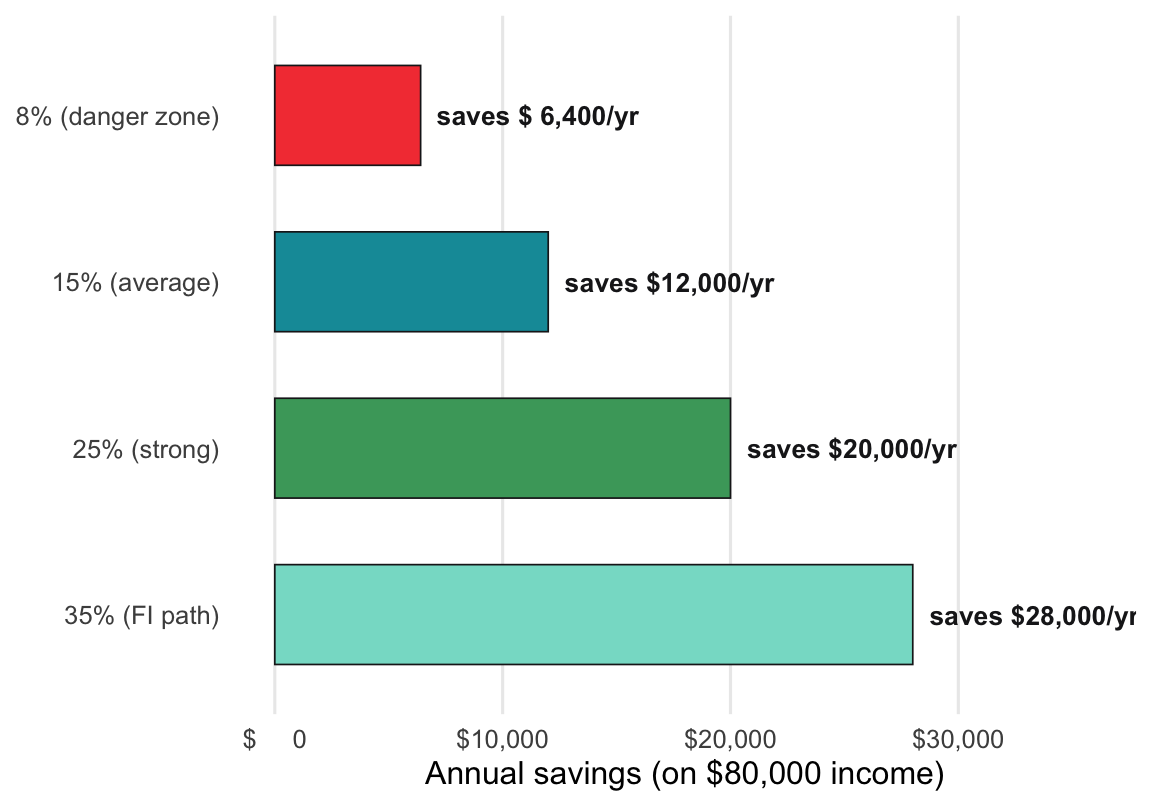
Your savings rate is the single lever you fully control that determines how fast wealth accumulates. John Bogle and Ben Felix both emphasize this: income is not destiny. A $40,000/year earner with a 40% savings rate will reach financial independence faster than a $120,000/year earner with a 10% rate. The chart below shows how dramatically the annual savings amount changes as the rate moves from the danger zone to the financial independence path—all on the same $60,000 income.
Benchmarks to know:
- <10%: Danger zone; financial independence feels impossible
- 10-20%: Average; slow but steady progress
- 20-30%: Strong; real wealth building begins
- 30%+: Path to financial independence within a decade or two
This difference is profound. The chart below compares two real scenarios: someone making $40,000/year saving 40% reaches financial independence faster than someone making $120,000/year saving only 10%. Despite earning $80,000 less annually, the higher savings rate compounds to wealth faster.
The low-income earner reaches $500k in 18 years. The high-income earner? 21 years. Savings rate determines speed, not salary.
6.2 Make Savings Automatic
Morgan Housel’s principle is powerful: saving consistently is harder than the math suggests because it requires fighting your psychology. Your brain wants to spend what’s available.
Three strategies improve compliance dramatically:
Automate it. Set up automatic transfers from checking to savings the day after payday. You never see the money, so you don’t miss it. Automation turns saving from willpower into habit—and willpower is finite.
Use a separate bank. If your savings account is at a different institution, moving money requires extra steps. That friction prevents impulse withdrawals. Psychological barriers work.
Label the account by purpose. “Emergency Fund” or “Car Repair Fund” is more protective than generic “Savings.” The label triggers commitment—you’ve told yourself what the money is for.
Track your progress visually. A chart showing balance rising toward your goal provides motivation. Sethi emphasizes behavioral compliance; seeing progress reinforces the habit.
Savings and the FOO
The Financial Order of Operations (Section 1) prioritizes savings at every step:
- Steps 1–2: Save for immediate protection (insurance deductibles, capture employer match)
- Steps 3–4: Save to eliminate high-interest debt and build emergency reserves
- Steps 5–7: Save through tax-advantaged investing (IRAs, 401k, taxable accounts)
- Step 8: Save for known future expenses (education, down payment, wedding)
- Step 9: Save extra toward low-interest debt payoff (optional)
This sequence is deliberate. Morgan Housel’s insight applies directly: before your savings can grow, it must be protected from being consumed by emergencies. Ben Felix’s research shows that behavioral compliance—actually following through—matters more than optimization. The right savings rate is one you can maintain for decades, not one that looks impressive on a spreadsheet for six months.
6.3 Savings Account Types
Not all savings accounts are equal. The right account depends on when you’ll need the money and how much growth you need.
| Account Type | Liquidity | Interest Rate | Best For |
|---|---|---|---|
| High-Yield Savings | Immediate (1–2 days) | 4–5% APY | Emergency fund, sinking funds |
| Money Market Account | Quick (3–5 days) | 4.5–5.5% APY | Emergency fund, flexibility |
| Certificate of Deposit (CD) | Fixed term (3–5 years) | 4–5.5% APY | Known future goal, discipline |
| Regular Savings | Immediate | 0.01–0.5% APY | Avoid; losing to inflation |
High-yield savings accounts (HYSAs) are the foundation. John Bogle’s principle of simplicity applies here: a HYSA costs nothing, requires no stock-picking, and guarantees you won’t lose your principal. You earn 4–5% APY while keeping money liquid for emergencies.
Ramit Sethi recommends automating your savings into a separate high-yield account at a different bank—not your regular checking account. The friction (money takes 1–2 days to transfer back) prevents impulsive withdrawals. The account becomes a psychological barrier between you and your savings.
NoteFDIC Insurance and Account Limits
FDIC insurance protects up to $250,000 per account holder per bank. If you save more than $250k, open accounts at different institutions. Most online banks (Ally, Marcus, American Express, Discover) offer competitive rates (4–5% APY).
6.4 Math for Saving
Calculate the Savings Rate
Your income is a single bar. Every dollar either goes to spending or savings. The savings rate simply measures: what slice of that bar is savings?
The chart below shows how this slice changes across four savings-rate tiers—all from the same $60,000 income.
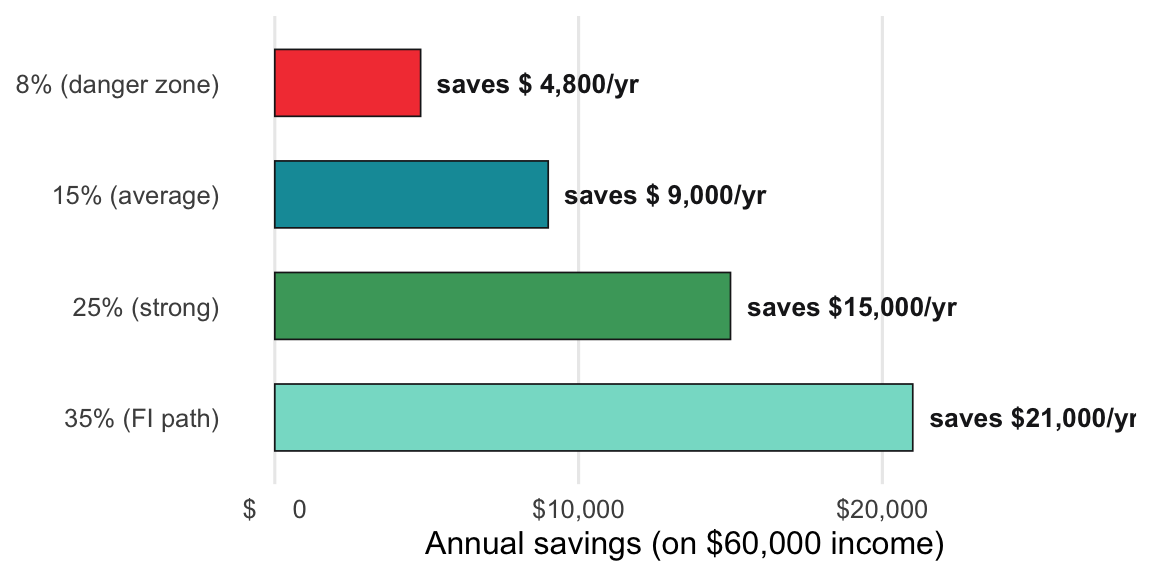
The formula translates this visual: divide the savings slice by the total bar, then multiply by 100 to express it as a percentage.
Formula: Savings Rate = (Income − Spending) ÷ Income × 100
Example: You take home $5,000 and spend $3,500. → (5,000 − 3,500) ÷ 5,000 = 30% savings rate.
show/hide
savings_rate <- function(income, spending) {
  ((income - spending) / income) * 100
}

# $5,000 take-home, $3,500 spent
savings_rate(income = 5000, spending = 3500)
#> [1] 30
show/hide
def savings_rate(income, spending):
    return ((income - spending) / income) * 100

# $5,000 take-home, $3,500 spent
savings_rate(income=5000, spending=3500)
#> 30.0
Assuming Income is in cell B2 and Spending is in cell C2:
=((B2 - C2) / B2) * 1006.5 Key Takeaways
- Your savings rate determines your timeline to financial independence. A 30% rate beats high income with low savings.
- Automate your savings. Willpower is finite. Pay yourself first by setting up automatic transfers; let the rest be your budget.
- High-yield savings accounts are foundational, not boring. 4–5% APY beats inflation and requires zero risk.
- Consistency beats optimization. A modest savings rate you maintain for 30 years outpaces aggressive saving you abandon after 18 months.
With a clear savings rate, automated transfers, and the right account to hold that money, your savings foundation is solid. The next step is protecting those savings with an emergency fund—which is where the next chapter goes.
Ramit Sethi’s Conscious Spending Plan embeds this principle: pay yourself (savings and investments) first as a percentage of income, then allocate the remainder to fixed costs, flexible spending, and guilt-free wants. This removes savings from willpower and makes it automatic.↩︎