%%{init: {'theme': 'neutral', 'themeVariables': { 'fontFamily': 'monospace', "darkMode":false, "fontSize":"16px"}}}%%

flowchart TD
    Crisis(["Unexpected Expense"]) --> NoFund{"Emergency Fund?"}
    NoFund -->|"No"| CreditCard("Charge It to<br>Credit Card")
    NoFund -->|"Yes"| EFund("Draw from<br>Emergency Fund")
    CreditCard --> Interest("Pay 20-24% Interest<br>for Months/Years")
    CreditCard --> Stress("Financial Stress<br>& Anxiety")
    EFund --> Solved("Problem Solved<br>No Debt Added")
    EFund --> Rebuild("Rebuild the Fund<br>Over Next Few Months")
    style Crisis fill:#f0cfcf,color:#1C1C1E,stroke:#1C1C1E,stroke-width:2px
    style NoFund fill:#f0cfcf,color:#1C1C1E,stroke:#1C1C1E,stroke-width:2px
    style CreditCard fill:#f44242,color:#F5F2E8,stroke:#1C1C1E,stroke-width:2px
    style Interest fill:#f44242,color:#F5F2E8,stroke:#1C1C1E,stroke-width:2px
    style Stress fill:#f44242,color:#F5F2E8,stroke:#1C1C1E,stroke-width:2px
    style EFund fill:#48a56a,color:#F5F2E8,stroke:#1C1C1E,stroke-width:2px
    style Solved fill:#86ddcd,color:#1C1C1E,stroke:#1C1C1E,stroke-width:2px
    style Rebuild fill:#86ddcd,color:#1C1C1E,stroke:#1C1C1E,stroke-width:2px
5 Emergency Fund
An emergency fund is cash set aside to handle the unexpected without reaching for credit. It’s the financial equivalent of a spare tire: you don’t need it most of the time, but when you do, nothing else will do the job.
The standard target is 3 to 6 months of essential expenses, parked somewhere safe and liquid. This is Step 4 of the Financial Order of Operations (Section 1), and it comes before investing, before extra debt payoff, before any goal other than capturing your employer match and eliminating high-interest debt.
This chapter covers:
- How much you actually need
- Where to keep it (and where not to)
- How to build it from scratch
- How to rebuild it after a withdrawal
5.1 Why It Matters
Most financial derailments don’t start with bad investing. They start with a single unexpected expense (a car repair, a medical bill, a job loss) that gets charged to a credit card because there’s no cash available.
Housel’s framing is useful here: an emergency fund isn’t about the return on the money. It’s about buying options: the ability to not be forced into a bad financial decision at a bad time. That optionality is worth more than any interest rate (Housel 2020).
5.2 How Much Do You Actually Need?
“3 to 6 months of expenses” is the standard answer, and it’s a reasonable starting range. But it isn’t a single number, because emergencies don’t affect everyone equally.
The Essential Expenses Baseline
Start by calculating your essential expenses: what it actually costs to keep the lights on. This is not your total spending; it’s the floor.
| Category | Examples |
|---|---|
| Housing | Rent or mortgage, renter’s/homeowner’s insurance |
| Food | Groceries (not dining out) |
| Utilities | Electricity, water, gas, internet |
| Transportation | Car payment, insurance, fuel, transit pass |
| Health | Insurance premiums, critical medications |
| Minimum debt payments | Credit card minimums, loan payments |
Entertainment, subscriptions, gym memberships, and dining out are not essential expenses for this calculation. In a true emergency, you can cut them. Your emergency fund is sized to cover the life you need, not the one you currently live.
Adjusting for Your Situation
The right target depends on how much income risk you carry. More risk = more months.
%%{init: {'theme': 'neutral', 'themeVariables': { 'fontFamily': 'monospace', "darkMode":false, "fontSize":"16px"}}}%%

flowchart TD
    Start(["How many months?"]) --> Job{"Job Stability?"}
    Job -->|"Stable<br>single income"| Dep{"Dependents?"}
    Job -->|"Variable / Self-Employed"| More("Lean toward<br>6–9 months")
    Dep -->|"No"| Insure{"Good health &<br>disability coverage?"}
    Dep -->|"Yes: kids, aging parents"| SixPlus("6 months minimum")
    Insure -->|"Yes"| ThreeToSix("3–4 months<br>is sufficient")
    Insure -->|"No"| SixMonths("Closer to<br>6 months")
    style Start fill:#48a56a,color:#F5F2E8,stroke:#1C1C1E,stroke-width:2px
    style Job fill:#f0cfcf,color:#1C1C1E,stroke:#1C1C1E,stroke-width:2px
    style More fill:#f44242,color:#F5F2E8,stroke:#1C1C1E,stroke-width:2px
    style Dep fill:#f0cfcf,color:#1C1C1E,stroke:#1C1C1E,stroke-width:2px
    style SixPlus fill:#0e9aa7,color:#F5F2E8,stroke:#1C1C1E,stroke-width:2px
    style Insure fill:#f0cfcf,color:#1C1C1E,stroke:#1C1C1E,stroke-width:2px
    style ThreeToSix fill:#86ddcd,color:#1C1C1E,stroke:#1C1C1E,stroke-width:2px
    style SixMonths fill:#0e9aa7,color:#F5F2E8,stroke:#1C1C1E,stroke-width:2px
A two-income household where both partners work stable salaried jobs has a lower emergency risk than a self-employed single parent. The fund should reflect that difference.
The Starter Fund First
Dave Ramsey popularized a practical approach (his Baby Step 1): build a $1,000 starter emergency fund immediately, even while paying down debt. Once high-interest debt is gone, shift the same monthly dollars you were paying toward debt into filling the emergency fund to its full target.
The sequence matters:
- Build $1,000 starter fund
- Eliminate credit card and high-interest debt (see Managing Debt)
- Build full 3–6 month fund
5.3 Emergency Reserves in the Financial Order of Operations
This sequence mirrors step 4 of Brian Preston’s Financial Order of Operations, introduced in Budgeting: emergency reserves are funded immediately after high-interest debt (step 3) and before Roth IRA/HSA contributions (step 5). See Managing Debt for how the two debt steps bracket this one.
Skipping ahead to invest before this step is funded exposes you to the exact sequencing risk described in Why Not the Stock Market? below. A market downturn and a job loss tend to arrive together.
5.4 Where to Keep It (and Where Not To)
An emergency fund has two jobs: stay safe and be available. This rules out most places you might initially consider.
%%{init: {'theme': 'neutral', 'themeVariables': { 'fontFamily': 'monospace', "darkMode":false, "fontSize":"16px"}}}%%

flowchart LR
    Cash(["Your Emergency<br>Fund"]) --> Good
    Cash --> Bad

    subgraph Good["<strong>GOOD OPTIONS</strong>"]
        HYSA("High-Yield Savings Account<br>(HYSA)")
        MMF("Money Market Fund<br>(at a brokerage)")
        CheckFed("Federally Insured<br>Credit Union")
    end

    subgraph Bad["<strong>BAD OPTIONS</strong>"]
        Checking("Regular Checking Account<br>(too easy to spend)")
        Market("Stock Market<br>(too volatile)")
        CD("Long-Term CDs<br>(penalties for early withdrawal)")
        Cash2("Physical Cash at Home<br>(no interest, risk of loss)")
    end

    style Cash fill:#48a56a,color:#F5F2E8,stroke:#1C1C1E,stroke-width:2px
    style Good fill:#0e9aa7,color:#F5F2E8,stroke:#1C1C1E,stroke-width:2px
    style Bad fill:#f44242,color:#F5F2E8,stroke:#1C1C1E,stroke-width:2px
    style HYSA fill:#86ddcd,color:#1C1C1E,stroke:#1C1C1E,stroke-width:2px
    style MMF fill:#86ddcd,color:#1C1C1E,stroke:#1C1C1E,stroke-width:2px
    style CheckFed fill:#86ddcd,color:#1C1C1E,stroke:#1C1C1E,stroke-width:2px
    style Checking fill:#f44242,color:#F5F2E8,stroke:#1C1C1E,stroke-width:2px
    style Market fill:#f44242,color:#F5F2E8,stroke:#1C1C1E,stroke-width:2px
    style CD fill:#f44242,color:#F5F2E8,stroke:#1C1C1E,stroke-width:2px
    style Cash2 fill:#f44242,color:#F5F2E8,stroke:#1C1C1E,stroke-width:2px
The Right Account
A high-yield savings account (HYSA) at an FDIC-insured bank is the default recommendation. It earns meaningfully more than a standard checking account while keeping the money one business day away. Credit union equivalents covered by NCUA insurance work the same way.
See High-Yield Accounts for a full breakdown of how to find and open one.
Why Not the Stock Market?
This is the most common mistake people make with emergency funds. The logic seems sound: “my money would earn more in index funds.” The problem is sequencing risk.
If you lose your job in February and the stock market is down 25% at the same moment (which historically happens; recessions cause both), you’re forced to sell at the worst possible time. The emergency fund’s job isn’t to grow wealth; it’s to be there when you need it, at full value, on demand.
Ben Felix approaches this through the lens of human capital. For most, your ability to earn an income is your largest asset. An emergency fund is a hedge against the volatility of that human capital. If your income is highly variable (e.g., sales commissions, freelancing, or business ownership), you should lean toward a larger cash buffer to protect your ability to maintain your lifestyle during lean periods.
5.5 Building Your Emergency Fund
For most people, building the fund from zero to 3–6 months takes 12–24 months of consistent contribution. The chart below shows the monthly balance for three different monthly contribution amounts toward a $15,000 target.
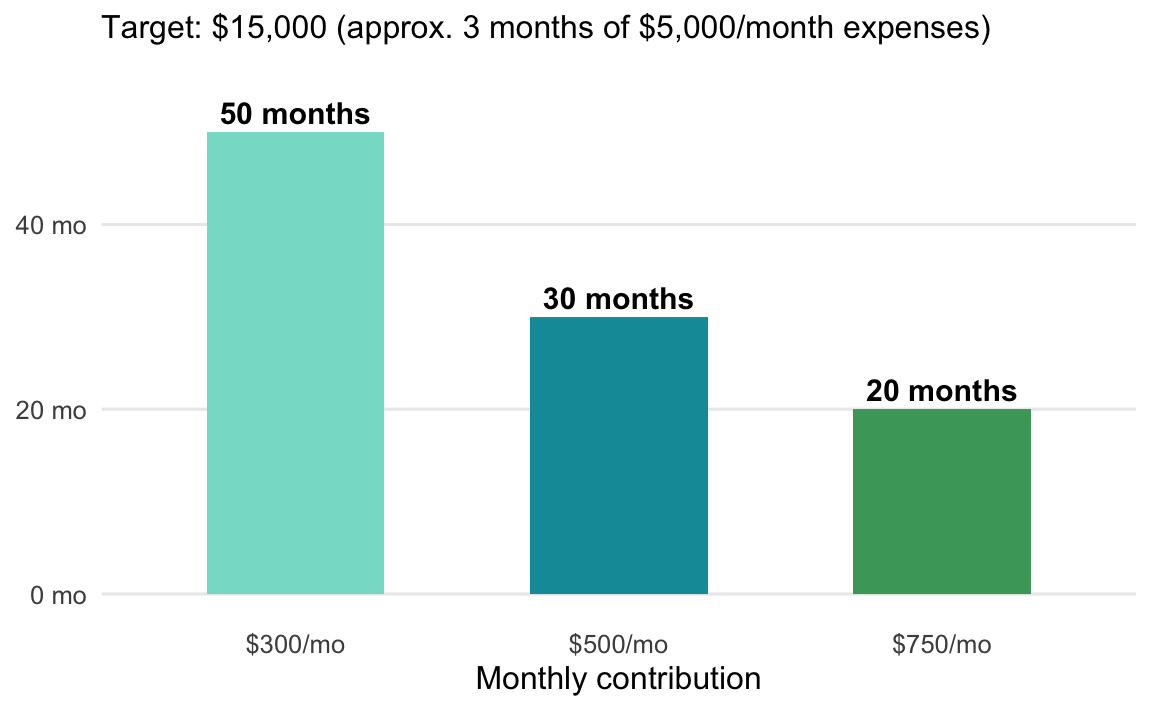
The pattern is simple: doubling the monthly contribution roughly halves the time to goal.
Automate It
The most reliable way to build the fund is to treat it exactly like a bill. Set up an automatic transfer to your HYSA on payday, before you have a chance to spend the money. See Automating Savings for the full setup playbook.
Where to Find the Money
If you’re reading this and thinking “I don’t have anything extra to save,” the answer is usually a combination of small cuts applied consistently:
- Pause one subscription
- Cook at home one extra night per week
- Redirect a tax refund directly to the fund
None of these feel dramatic. That’s the point. The fund gets built one unexciting month at a time.
5.6 How to Rebuild After a Withdrawal
Using the emergency fund isn’t a failure; it’s the fund doing its job. The mistake is treating a withdrawal as a one-time event rather than a signal to rebuild immediately.
%%{init: {'theme': 'neutral', 'themeVariables': { 'fontFamily': 'monospace', "darkMode":false, "fontSize":"16px"}}}%%

flowchart TD
    Use(["Emergency: Fund Used"]) --> Assess("Assess: How much<br>was withdrawn?")
    Assess --> Resume("Resume automatic<br>contributions immediately")
    Resume --> Temp{"Can you temporarily<br>increase contributions?"}
    Temp -->|"Yes"| Boost("Increase monthly<br>contribution until rebuilt")
    Temp -->|"No"| Steady("Maintain existing<br>contribution; stay patient")
    Boost --> Target(["Fund Restored"])
    Steady --> Target
    style Use fill:#f0cfcf,color:#1C1C1E,stroke:#1C1C1E,stroke-width:2px
    style Assess fill:#0e9aa7,color:#F5F2E8,stroke:#1C1C1E,stroke-width:2px
    style Resume fill:#0e9aa7,color:#F5F2E8,stroke:#1C1C1E,stroke-width:2px
    style Temp fill:#f0cfcf,color:#1C1C1E,stroke:#1C1C1E,stroke-width:2px
    style Boost fill:#48a56a,color:#F5F2E8,stroke:#1C1C1E,stroke-width:2px
    style Steady fill:#86ddcd,color:#1C1C1E,stroke:#1C1C1E,stroke-width:2px
    style Target fill:#48a56a,color:#F5F2E8,stroke:#1C1C1E,stroke-width:2px
Two rules for the rebuild phase:
Don’t stop other savings to rebuild faster. The automatic contributions will get you there. Don’t interrupt retirement account contributions, especially if you have an employer match.
Don’t restart debt payoff conversations during the rebuild. Your priority order right now is: minimum payments on everything, then rebuild the emergency fund, then return to accelerated debt payoff.
5.7 Math for Emergency Funds
The calculations here are simple, but writing them down forces you to confront the actual numbers.
Your Target Amount
Your emergency fund target is just essential monthly expenses multiplied by the number of months you want to cover.
The chart below shows how the target grows as you add months; each bar is the previous one plus one more month of expenses.
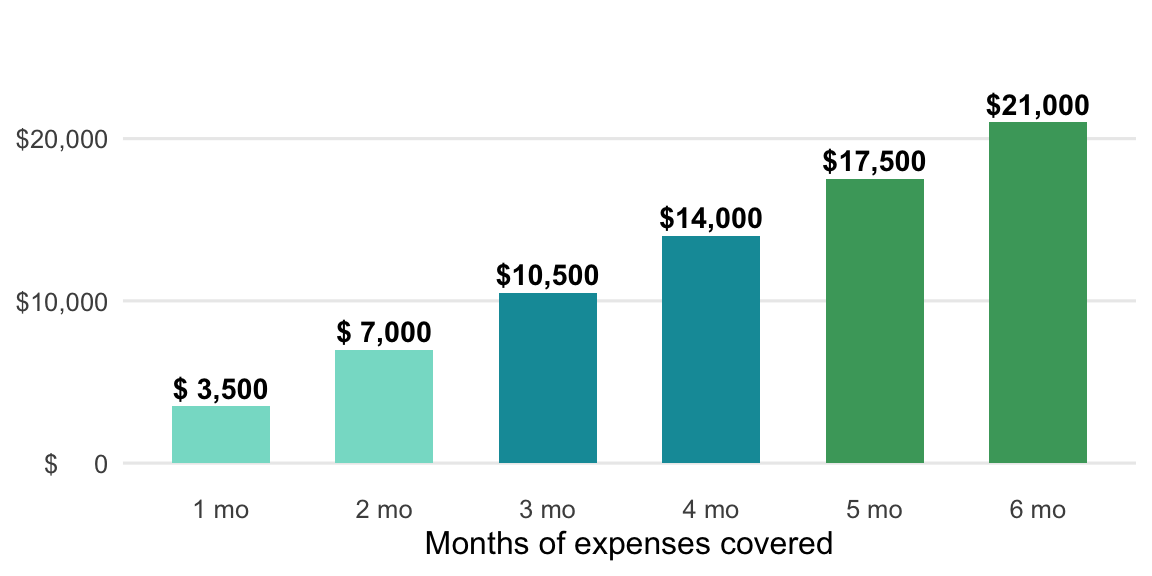
Formula: Target = Monthly Essential Expenses × Months of Coverage
Example: $3,500/month in essential expenses × 4 months = $14,000 target.
In R, emergency_fund_target() multiplies your essential monthly expenses by the number of months you want covered.
show/hide
emergency_fund_target <- function(monthly_expenses, months = 3) {
  monthly_expenses * months
}

# $3,500/month in essential expenses, 3-month and 6-month targets
emergency_fund_target(monthly_expenses = 3500, months = 3)
#> [1] 10500
emergency_fund_target(monthly_expenses = 3500, months = 6)
#> [1] 21000
The Python version of emergency_fund_target() works the same way:
show/hide
def emergency_fund_target(monthly_expenses, months=3):
    return monthly_expenses * months

# $3,500/month in essential expenses, 3-month and 6-month targets
print(emergency_fund_target(monthly_expenses=3500, months=3))
#> 10500
print(emergency_fund_target(monthly_expenses=3500, months=6))
#> 21000
Assuming essential monthly expenses are in cell A2 and the number of months is in B2:
=A2*B2Months to Reach Your Target
Given your current balance and a monthly contribution, how long until you reach the target?
Formula: Months to Goal = (Target − Current Balance) ÷ Monthly Contribution
Example: $14,000 target, $2,000 already saved, contributing $500/month → (14,000 − 2,000) ÷ 500 = 24 months.
In R, months_to_ef_goal() subtracts what you’ve already saved from the target, then divides what’s left by your monthly contribution.
show/hide
months_to_ef_goal <- function(target, current_balance, monthly_contribution) {
  remaining <- max(0, target - current_balance)
  ceiling(remaining / monthly_contribution)
}

# $14,000 target, $2,000 saved, $500/month contribution
months_to_ef_goal(target = 14000, current_balance = 2000, monthly_contribution = 500)
#> [1] 24
The Python version of months_to_ef_goal() works the same way:
show/hide
import math

def months_to_ef_goal(target, current_balance, monthly_contribution):
    remaining = max(0, target - current_balance)
    return math.ceil(remaining / monthly_contribution)

# $14,000 target, $2,000 saved, $500/month contribution
print(months_to_ef_goal(target=14000, current_balance=2000, monthly_contribution=500))
#> 24
Assuming the target is in A2, your current balance is in B2, and your monthly contribution is in C2:
=ROUNDUP(MAX(0, A2-B2)/C2, 0)Contribution Needed by a Deadline
Working backwards: if you want to reach your target in a specific number of months, how much do you need to save each month?
Formula: Monthly Contribution = (Target − Current Balance) ÷ Months Remaining
Example: You want a full $14,000 fund in 18 months and have $2,000 now → (14,000 − 2,000) ÷ 18 = $667/month.
In R, monthly_contribution_needed() flips the question: given a deadline, it returns the monthly amount you need to save.
show/hide
monthly_contribution_needed <- function(target, current_balance, months) {
  remaining <- max(0, target - current_balance)
  ceiling(remaining / months)
}

# $14,000 target, $2,000 saved, want to finish in 18 months
monthly_contribution_needed(target = 14000, current_balance = 2000, months = 18)
#> [1] 667
The Python version of monthly_contribution_needed() works the same way:
show/hide
def monthly_contribution_needed(target, current_balance, months):
    remaining = max(0, target - current_balance)
    return math.ceil(remaining / months)

# $14,000 target, $2,000 saved, want to finish in 18 months
print(monthly_contribution_needed(target=14000, current_balance=2000, months=18))
#> 667
Assuming the target is in A2, your current balance is in B2, and the number of months is in C2:
=ROUNDUP(MAX(0, A2-B2)/C2, 0)What the Fund Earns While You Build It
Keeping the fund in a HYSA means it earns interest as it grows. This won’t dramatically change your timeline, but it’s real money.
Formula: Future Value = Balance × (1 + monthly rate)^months
Where monthly rate = annual rate ÷ 12.
Example: $14,000 in a HYSA at 4.5% APY, untouched for 12 months → ~$14,630. The interest pays for a car repair without reducing your fund.
In R, ef_growth() grows a balance month by month at a given annual rate.
show/hide
ef_growth <- function(balance, annual_rate, months) {
  monthly_rate <- annual_rate / 12
  balance * (1 + monthly_rate)^months
}

# $14,000 at 4.5% APY for 12 months
ef_growth(balance = 14000, annual_rate = 0.045, months = 12)
#> [1] 14643.16
The Python version of ef_growth() works the same way:
show/hide
def ef_growth(balance, annual_rate, months):
    monthly_rate = annual_rate / 12
    return balance * (1 + monthly_rate) ** months

# $14,000 at 4.5% APY for 12 months
print(ef_growth(balance=14000, annual_rate=0.045, months=12))
#> 14643.157550568254
Assuming the balance is in A2, the annual rate is in B2 (as a decimal), and the number of months is in C2:
=A2*(1+B2/12)^C25.8 Putting It All Together
%%{init: {'theme': 'neutral', 'themeVariables': { 'fontFamily': 'monospace', "darkMode":false, "fontSize":"16px"}}}%%

flowchart TD
    Start(["Build Your<br>Emergency Fund"]) --> Step1("i. Calculate monthly<br>essential expenses")
    Step1 --> Step2("ii. Choose your target:<br>3–6 months, based on risk")
    Step2 --> Step3("iii. Open a<br>dedicated HYSA")
    Step3 --> Step4("iv. Set up automatic<br>monthly transfer on payday")
    Step4 --> Step5("v. Build $1,000 starter<br>fund first if in debt")
    Step5 --> Step6("vi. Pay off high-interest<br>debt, then fill full fund")
    Step6 --> Step7("vii. Once funded, leave it<br>alone; it's not savings")
    Step7 --> Step8(["viii. Rebuild immediately<br>after any withdrawal"])
    style Start fill:#48a56a,color:#F5F2E8,stroke:#1C1C1E,stroke-width:2px
    style Step1 fill:#0e9aa7,color:#F5F2E8,stroke:#1C1C1E,stroke-width:2px
    style Step2 fill:#0e9aa7,color:#F5F2E8,stroke:#1C1C1E,stroke-width:2px
    style Step3 fill:#0e9aa7,color:#F5F2E8,stroke:#1C1C1E,stroke-width:2px
    style Step4 fill:#0e9aa7,color:#F5F2E8,stroke:#1C1C1E,stroke-width:2px
    style Step5 fill:#0e9aa7,color:#F5F2E8,stroke:#1C1C1E,stroke-width:2px
    style Step6 fill:#0e9aa7,color:#F5F2E8,stroke:#1C1C1E,stroke-width:2px
    style Step7 fill:#0e9aa7,color:#F5F2E8,stroke:#1C1C1E,stroke-width:2px
    style Step8 fill:#86ddcd,color:#1C1C1E,stroke:#1C1C1E,stroke-width:2px
5.9 Recap
An emergency fund is not an investment. It’s insurance, and the cost of that insurance is the interest you don’t earn by keeping it in cash instead of equities. That’s a reasonable price for what it buys.
- Size it to your actual risk. Stable salaried job with good coverage? Three months is fine. Variable income or dependents? Six months or more.
- Keep it separate. A dedicated HYSA with a slight friction to transfer prevents casual spending from eroding the fund.
- Build it in stages. $1,000 starter fund first, then full fund after high-interest debt is cleared.
- Automate the contribution. Set it on payday and treat it like a bill until the fund is full.
- Rebuild immediately after using it. The fund only works if it’s there the next time you need it.
As Housel writes, the point of financial margin isn’t to optimize; it’s to survive. An emergency fund doesn’t make you rich. It keeps a bad month from becoming a bad decade.