Insurance is for losses you can’t absorb on your own. You pay a small, certain cost (the premium) to avoid a large, uncertain one. Your emergency fund handles the small surprises; insurance handles the ones that would wipe it out and keep going.
That idea gives you a simple rule for every policy in this chapter: buy enough to cover the catastrophic, and skip the small policies that turn premiums into a slow leak. Morgan Housel calls this leaving room for error. The goal isn’t to avoid every bad outcome; it’s to make sure no single bad outcome can knock you out of the game 1.
Every type of insurance uses the same handful of terms:
Premiums and deductibles move in opposite directions. A higher deductible means a lower premium, because you’re agreeing to cover more of each loss yourself. Once you have an emergency fund, a higher deductible is often the cheaper choice. The math section below shows how to check.
Health insurance is the one policy nobody should go without. A single hospital stay can cost tens of thousands of dollars, and medical bills are one of the most common reasons people fall into debt.
You have three common ways to get it when you’re starting out:
Health plans add three more terms to the list:
The out of pocket maximum is the most important number on the plan. It’s your worst case. In 2026, it can’t be higher than $10,600 for one person, and many employer plans set it much lower 2.
If your employer offers a high deductible health plan, compare it carefully. These plans have lower premiums and let you open an HSA, the account covered in Retirement Accounts. In 2026, a plan qualifies if its deductible is at least $1,700 and its out of pocket maximum is no more than $8,500 for one person 3. For a healthy young person, especially one whose employer adds money to the HSA, the high deductible plan is often the cheaper choice. The math section compares two plans side by side.
If you own a car, you’re required to carry auto insurance, but the minimum your state requires is usually far too low. Liability coverage is the part that protects you, not your car: if you cause an accident, it pays for the other person’s injuries and damage. If your coverage runs out, you can be sued for the rest.
Most experts, including Consumer Reports and the Insurance Information Institute, recommend liability limits of at least 100/300/100 4: $100,000 per person injured, $300,000 per accident, and $100,000 for property damage. The jump from the state minimum to these limits often costs less than people expect.
Auto policies have two other main parts:
If your car is worth only a few thousand dollars, consider dropping collision and comprehensive. If the most they’d ever pay is the car’s value minus your deductible, a few years of premiums can add up to more than that.
Renters insurance is the best deal in insurance for someone who just moved out. Your landlord’s insurance covers the building, not your things. Renters insurance covers your belongings if they’re stolen or destroyed, pays for a place to stay if your apartment becomes unlivable, and includes liability coverage if someone gets hurt in your home or you accidentally damage someone else’s.
It typically costs about $13 to $23 a month, depending on where you live and how much coverage you choose 5. Some landlords require it. Even if yours doesn’t, get it. Choose “replacement cost” coverage, which pays what it costs to buy your things new, instead of “actual cash value,” which pays what your used things were worth.
Your biggest financial asset when you’re starting out isn’t your savings. It’s your ability to earn a paycheck for the next 40 years. Disability insurance replaces part of your income if an illness or injury keeps you from working.
This is the policy young people most often overlook, even though the risk is real. The Social Security Administration estimates that about 1 in 4 of today’s 20 year olds will become disabled before reaching retirement age 6.
Check your benefits at work first. Many employers offer long term disability insurance that replaces about 60% of your pay 7, often for free or a few dollars a month. If it’s offered, take it. If it’s not, look into an individual policy once you have a steady income.
Life insurance pays money to someone else when you die. That means you only need it if someone depends on your income: a spouse, a child, or a family member you support. If no one would be hurt financially by losing your paycheck, you don’t need it yet.
When you do need it, buy term life insurance. It covers you for a set number of years (often 20 or 30), costs little when you’re young and healthy, and pays a large amount if you die during the term. A common starting point is coverage of about 10 times your yearly income 8, for long enough to get your dependents to adulthood.
Avoid whole life and other “permanent” policies that combine insurance with an investment account. They cost many times more than term insurance for the same coverage, and the investment part usually grows more slowly than the index funds from Index Funds. Salespeople earn large commissions on these policies, which is why they’re pushed so hard.
An umbrella policy adds extra liability coverage on top of your auto and renters or homeowners insurance, usually in amounts of $1 million or more, for a few hundred dollars a year. It protects people who have a lot to lose in a lawsuit. When you’re starting out, you probably don’t need it. Revisit it once your net worth or income grows, or if you own a home, a pool, or a dog.
Plenty of insurance products cost more than they’re worth. Some common ones:
The test for each one is the same: if the loss would hurt but wouldn’t wreck your finances, cover it yourself.
Insurance math helps you make two everyday choices: which deductible to pick, and which health plan costs less over a year.
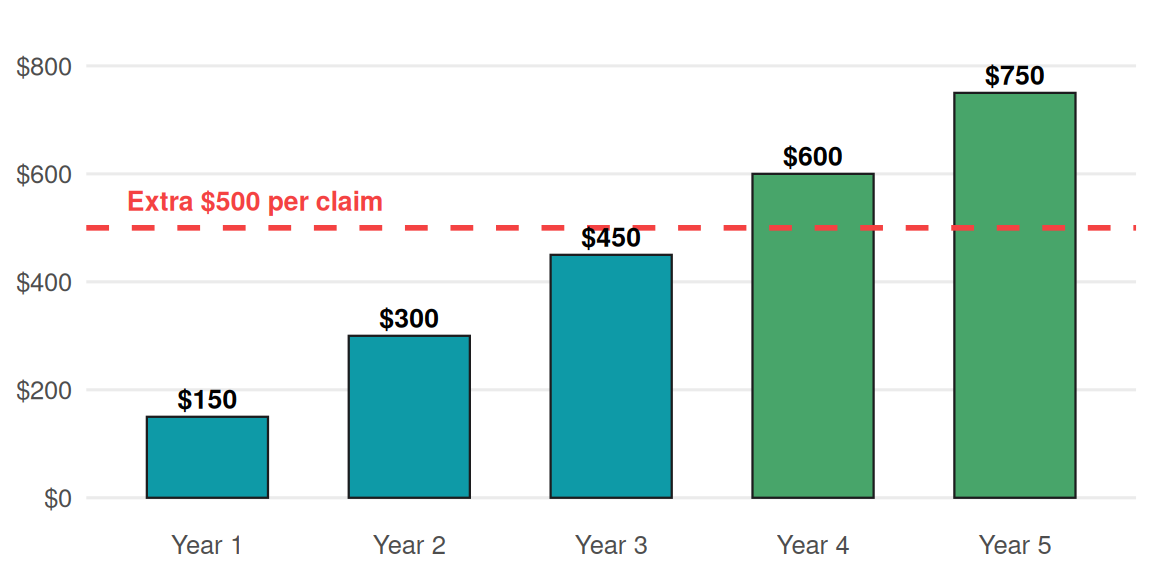
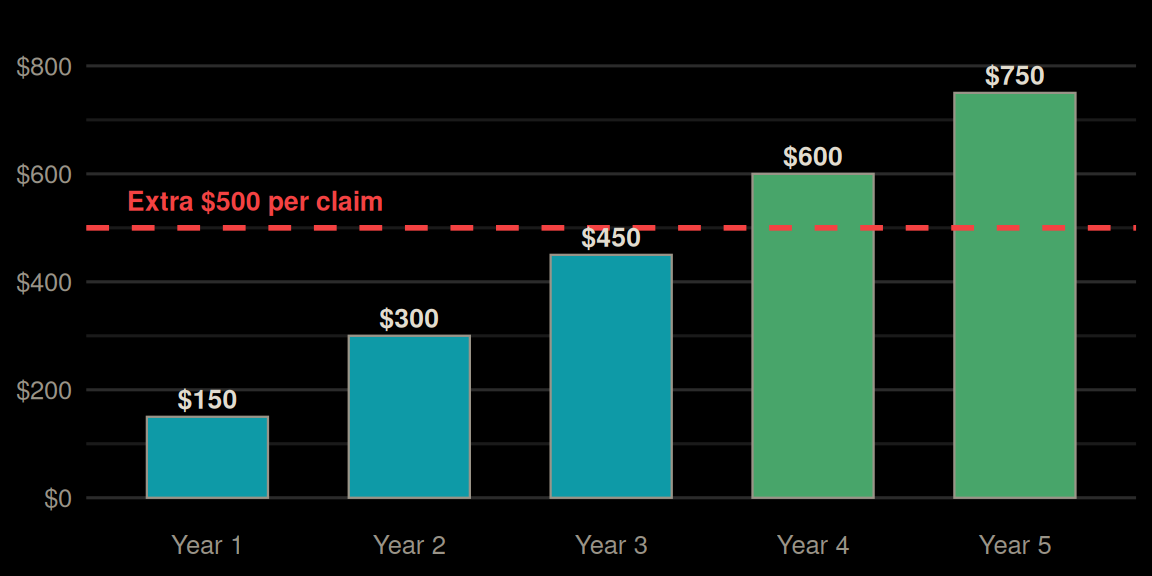
Say your car insurance costs $1,500 a year with a $500 deductible, or $1,350 a year with a $1,000 deductible. The higher deductible saves $150 a year, but costs you $500 more each time you file a claim. Each bar below is the savings piling up year after year; the red line is the extra $500 you’d pay on a claim.
The savings pass the extra deductible a little after year 3. If you file a claim less often than that, the higher deductible comes out ahead.
Formula: Break even years = (Higher deductible − Lower deductible) ÷ Yearly premium savings
Example: ($1,000 − $500) ÷ $150 = about 3.3 years. Most drivers go much longer than that between claims. Pick the higher deductible only if your emergency fund can cover it.
Check: after 3 years you have saved 3 × $150 = $450, and after 4 years $600, so the $500 gap is passed between year 3 and year 4.
Assuming the higher deductible is in B2, the lower deductible is in C2, and the yearly savings is in D2:
=(B2 - C2) / D2def break_even_years(high_deductible, low_deductible, yearly_savings):
return (high_deductible - low_deductible) / yearly_savings
# $1,000 vs. $500 deductible, saving $150 a year
break_even_years(high_deductible=1000, low_deductible=500, yearly_savings=150)
#> 3.3333333333333335break_even_years <- function(high_deductible, low_deductible, yearly_savings) {
(high_deductible - low_deductible) / yearly_savings
}
# $1,000 vs. $500 deductible, saving $150 a year
break_even_years(high_deductible = 1000, low_deductible = 500, yearly_savings = 150)
#> [1] 3.333333Imagine your job offers two plans. Plan A has a $100 monthly premium, a low deductible, and a $3,000 out of pocket maximum. Plan B is a high deductible plan with a $40 monthly premium, a $5,000 out of pocket maximum, and $500 a year that your employer puts into your HSA. The chart below shows what each plan costs in a healthy year (about $300 in doctor visits and prescriptions) and in the worst year possible.
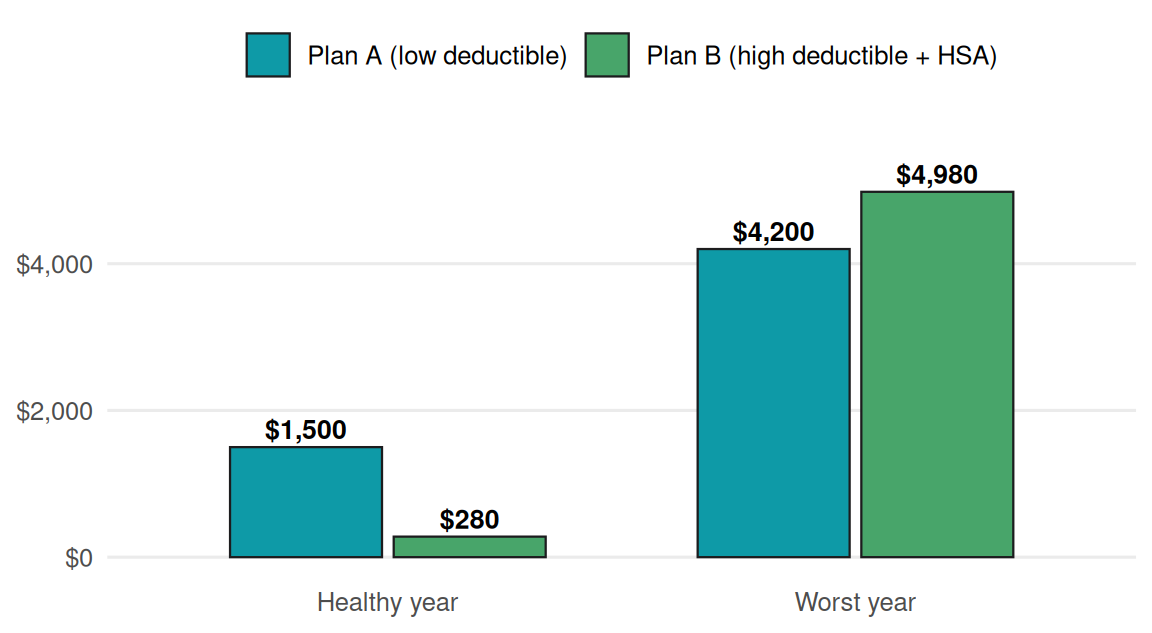
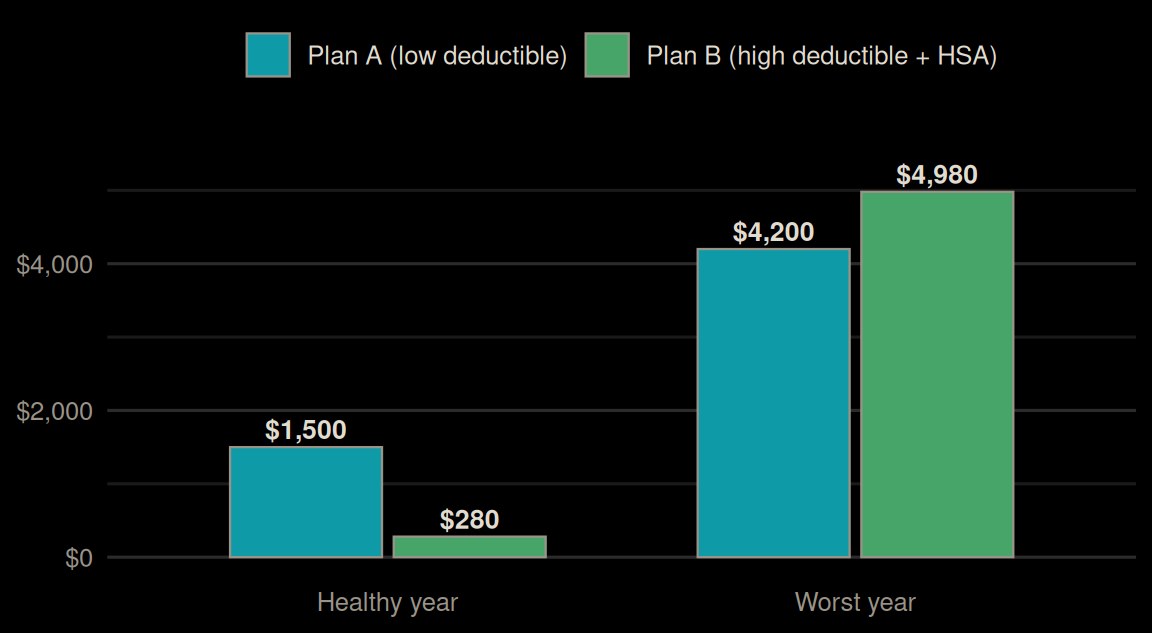
Each bar is a year of premiums, plus your share of medical bills (never more than the out of pocket maximum), minus any money your employer adds to your HSA.
Formula: Yearly cost = (Monthly premium × 12) + min(Medical bills, Out of pocket max) − Employer HSA money
This simple version assumes you pay all medical bills up to the out of pocket maximum, which makes it a slight overestimate for plans with coinsurance.
Example: In a healthy year, Plan A costs $1,500 and Plan B costs $280. In the worst year, Plan A costs $4,200 and Plan B costs $4,980. Plan B saves $1,220 in a normal year and costs $780 more in the worst year. If you put the savings into the HSA, one or two healthy years cover the difference.
Check: in a healthy year the bills match, so the gap is the premiums plus the HSA money: $1,200 − $480 + $500 = $1,220. In the worst year the $2,000 gap in out of pocket maximums eats that, leaving $2,000 − $1,220 = $780.
Assuming the monthly premium is in B2, medical bills in C2, the out of pocket maximum in D2, and employer HSA money in E2:
=B2 * 12 + MIN(C2, D2) - E2import polars as pl
def plan_cost(monthly_premium, medical_cost, oop_max, employer_hsa=0):
return monthly_premium * 12 + min(medical_cost, oop_max) - employer_hsa
# Plan A vs. Plan B in a healthy year ($300 of care) and the worst year
pl.DataFrame({
"year": ["healthy", "worst"],
"plan_a": [plan_cost(100, c, oop_max=3000) for c in (300, float("inf"))],
"plan_b": [plan_cost(40, c, oop_max=5000, employer_hsa=500) for c in (300, float("inf"))],
})| year | plan_a | plan_b |
|---|---|---|
| str | i64 | i64 |
| "healthy" | 1500 | 280 |
| "worst" | 4200 | 4980 |
import pandas as pd

def plan_cost(monthly_premium, medical_cost, oop_max, employer_hsa=0):
    return monthly_premium * 12 + min(medical_cost, oop_max) - employer_hsa

# Plan A vs. Plan B in a healthy year ($300 of care) and the worst year
pd.DataFrame({
    "year": ["healthy", "worst"],
    "plan_a": [plan_cost(100, c, oop_max=3000) for c in (300, float("inf"))],
    "plan_b": [plan_cost(40, c, oop_max=5000, employer_hsa=500) for c in (300, float("inf"))],
})
#>       year  plan_a  plan_b
#> 0  healthy    1500     280
#> 1 worst 4200 4980plan_cost <- function(monthly_premium, medical_cost, oop_max, employer_hsa = 0) {
monthly_premium * 12 + pmin(medical_cost, oop_max) - employer_hsa
}
# Plan A vs. Plan B in a healthy year ($300 of care) and the worst year
data.frame(
year = c("healthy", "worst"),
plan_a = plan_cost(100, c(300, Inf), oop_max = 3000),
plan_b = plan_cost(40, c(300, Inf), oop_max = 5000, employer_hsa = 500)
)
#> # A tibble: 2 × 3
#> year plan_a plan_b
#> <chr> <dbl> <dbl>
#> 1 healthy 1500 280
#> 2 worst 4200 4980plan_cost <- function(monthly_premium, medical_cost, oop_max, employer_hsa = 0) {
monthly_premium * 12 + pmin(medical_cost, oop_max) - employer_hsa
}
# Plan A vs. Plan B in a healthy year ($300 of care) and the worst year
data.table::data.table(
year = c("healthy", "worst"),
plan_a = plan_cost(100, c(300, Inf), oop_max = 3000),
plan_b = plan_cost(40, c(300, Inf), oop_max = 5000, employer_hsa = 500)
)
#> # A tibble: 2 × 3
#> year plan_a plan_b
#> <chr> <dbl> <dbl>
#> 1 healthy 1500 280
#> 2 worst 4200 4980This chapter closes the taxes and insurance part of the book. The next part turns to planning: setting goals, making big purchases, and getting your affairs in order.
The Psychology of Money: Timeless Lessons on Wealth, Greed, and Happiness. Housel, Morgan. 2020.↩︎
2026 HSA, HDHP and Excepted-Benefit HRA Figures Set. Mercer. 2025.↩︎
2026 HSA, HDHP and Excepted-Benefit HRA Figures Set. Mercer. 2025.↩︎
How Much Car Insurance Do I Need?. Consumer Reports. 2025.↩︎
The Average Renters Insurance Cost for 2026. NerdWallet. 2026.↩︎
Actuarial Note Number 2026.6. Social Security Administration, Office of the Chief Actuary. 2026.↩︎
Is Disability Insurance a Necessity? (And How Much Do You Need?). The Money Guy Show. 2024.↩︎
How Much Insurance Do I Need?. The Money Guy Show. 2024.↩︎