one_year = hysa_balance(principal=9600, annual_apy=0.04)
one_year, one_year - 9600
(9984.0, 384.0)Where should your savings live, and what does that choice earn? The High-Yield Savings Accounts chapter of the book makes the case for a high yield savings account (HYSA) at an online bank: it’s insured, you can reach the money in a day or two, and it pays far more than a big bank’s basic savings account. In this page I’ll put numbers on that case with hysa_balance(), using the chapter’s $9,600 emergency fund so you can check every result against the book.
hysa_balance() follows the conventions on the Get started page: the APY goes in as a decimal, and every argument accepts arrays.
| Function | Returns | Units |
|---|---|---|
| hysa_balance() | the balance after growing at an APY for some years | dollars (annual_apy is a decimal; years defaults to 1) |
The chapter follows the $9,600 emergency fund from Emergency Fund into a HYSA paying 4% APY. The APY (annual percentage yield) already includes daily compounding, so a year of growth is one multiplication by 1.04:
one_year = hysa_balance(principal=9600, annual_apy=0.04)
one_year, one_year - 9600(9984.0, 384.0)After one year the fund holds $9,984, and $384 of that is interest. years defaults to 1, so the call above doesn’t need it.
Leave the money alone and each year multiplies the previous balance by 1.04 again. The chapter draws each year as a bar split into the money you put in and the interest it has earned so far:
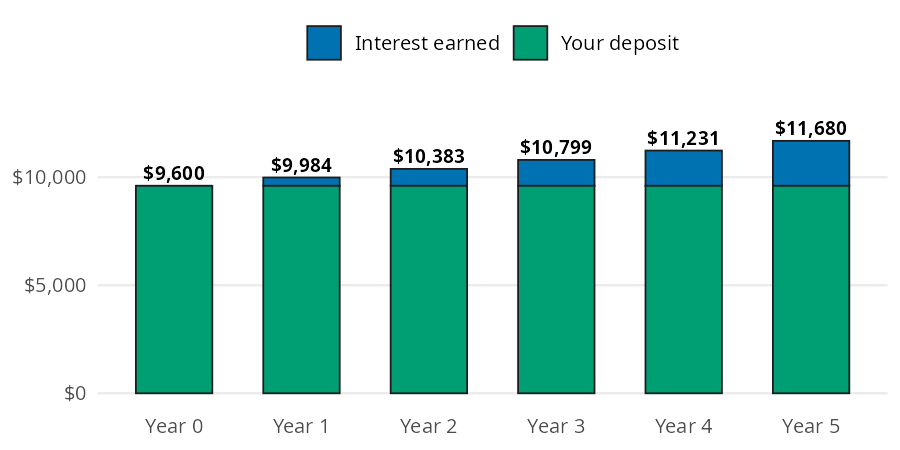
The bluish green base never changes; only the blue interest layer grows. Passing several values to years reproduces every bar in one call:
years = list(range(6))
balances = hysa_balance(principal=9600, annual_apy=0.04, years=years)
pl.DataFrame({
    "years": years,
    "deposit": [9600] * 6,
    "interest": balances - 9600,
    "balance": balances,
}).with_columns(pl.col("interest", "balance").round(2))| years | deposit | interest | balance |
|---|---|---|---|
| i64 | i64 | f64 | f64 |
| 0 | 9600 | 0.0 | 9600.0 |
| 1 | 9600 | 384.0 | 9984.0 |
| 2 | 9600 | 783.36 | 10383.36 |
| 3 | 9600 | 1198.69 | 10798.69 |
| 4 | 9600 | 1630.64 | 11230.64 |
| 5 | 9600 | 2079.87 | 11679.87 |
After five years the fund holds $11,679.87, which is the chapter’s $11,680. That’s $2,080 of growth without putting a dollar of the deposit at risk.
The chapter compares account types rather than banks. In late 2026 the national average savings rate was 0.39%, a big bank’s basic account often paid 0.01%, and the best online accounts paid 3.8% to 4.2%. annual_apy accepts an array, so one call compares a $10,000 balance across all of them:
apys = [0.0001, 0.0039, 0.038, 0.04, 0.042]
pl.DataFrame({
    "account": ["big bank basic", "national average", "online low", "online typical", "online high"],
    "apy": apys,
    "interest_year_1": hysa_balance(principal=10000, annual_apy=apys) - 10000,
}).with_columns(pl.col("interest_year_1").round(2))| account | apy | interest_year_1 |
|---|---|---|
| str | f64 | f64 |
| "big bank basic" | 0.0001 | 1.0 |
| "national average" | 0.0039 | 39.0 |
| "online low" | 0.038 | 380.0 |
| "online typical" | 0.04 | 400.0 |
| "online high" | 0.042 | 420.0 |
The gap between online banks is small: $40 a year separates the low and high ends on $10,000. The gap between an online bank and a big bank’s basic account is large: $400 against $1. As the chapter puts it, pick an online HYSA and don’t overthink which one.
hysa_balance() grows one lump sum at one rate, so it leaves out a few things:
annual_apy or years returns a result instead of an error.The chapter’s two headline numbers are an APY and an emergency fund, and both come from other chapters’ functions. Banks sometimes advertise an APR, the rate before compounding. apr_to_apy() from Managing Debt converts it with daily compounding, the way most HYSAs pay:
apy = apr_to_apy(apr=0.0392)
apy0.03997626956226452A 3.92% APR compounded daily is an APY of 4.00%. Next, emergency_fund_target() from Emergency Fund sets the balance to park: four months of $2,400 in essential expenses. We can then compare that fund after five years in the HYSA and in a big bank’s basic account:
ef_target = emergency_fund_target(monthly_expenses=2400, months=4)
in_hysa = hysa_balance(principal=ef_target, annual_apy=apy, years=5)
in_basic = hysa_balance(principal=ef_target, annual_apy=0.0001, years=5)
ef_target, round(in_hysa, 2), round(in_basic, 2)
(9600.0, 11678.54, 9604.8)The same $9,600 fund grows to $11,678.54 in the HYSA and $9,604.80 at the big bank, a difference of $2,074. Finally, ef_growth() from the Emergency Fund chapter does the same math in months, which helps when a goal doesn’t land on a whole year:
ef_growth(balance=ef_target, apy=0.04, months=[12, 18])array([ 9984. , 10181.72216474])Twelve months matches hysa_balance() with the default one year, and 18 months shows the balance halfway through year two.
A HYSA keeps your savings safe and reachable while paying hundreds of times what a basic account pays. hysa_balance() grows a balance at an APY, and passing several years or several APYs compares horizons and accounts in one call. With apr_to_apy(), emergency_fund_target(), and ef_growth(), it shows what an emergency fund earns while it waits.