Each topic starts with a real scenario and a bar model, then three levels of exercises. Level 1 (Guided) fills in the blanks of a finished function. Level 2 (Practice) applies it to new numbers. Level 3 (Challenge) asks a new question with little scaffolding. The R and Python exercises run in your browser: click Run Code to try, Submit Answer to check, and use the hint or solution if you get stuck. Excel exercises have a solution you can reveal.
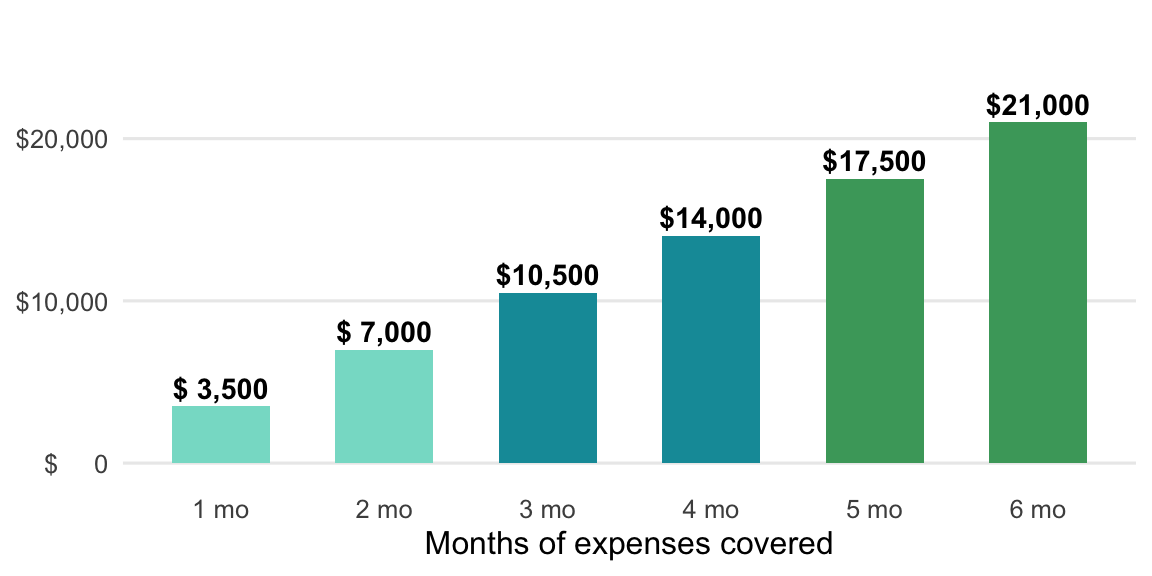
Your target is your essential monthly expenses multiplied by the number of months you want to cover. Each extra month adds one more block of expenses.
Formula: Target = Monthly Essential Expenses × Months of Coverage
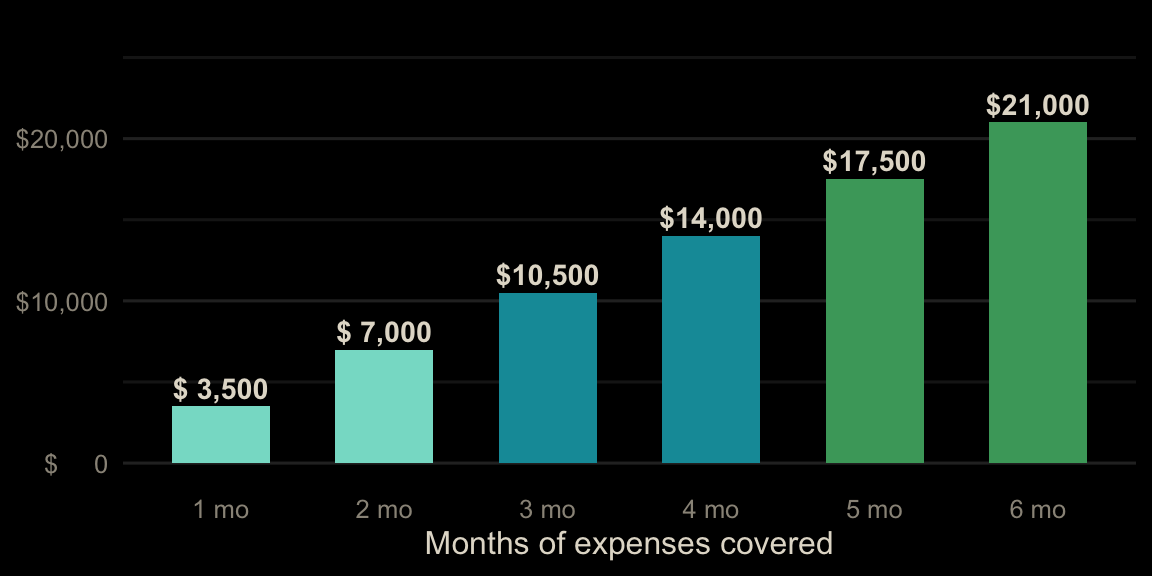
Book example: $3,500/month in essential expenses × 4 months = $14,000. The 3 and 6 month targets are $10,500 and $21,000.
Fill in the blanks to finish emergency_fund_target(), then find the target for $3,500 of essential expenses and 4 months of coverage.
Put essential expenses in A2 (3500) and months in B2 (4). Find the target in C2.
=A2 * B2This returns $14,000.
One block of expenses for every month you want covered.
def emergency_fund_target(monthly_expenses, months=3):
    return monthly_expenses * months

emergency_fund_target(3500, months=4)
One block of expenses for every month you want covered.
emergency_fund_target <- function(monthly_expenses, months = 3) {
  monthly_expenses * months
}
emergency_fund_target(3500, months = 4)Build the essential expenses from the book’s baseline (housing $1,600, groceries $550, utilities $300, transportation $600, health $250, minimum debt payments $200), then find a 6-month target.
Put the categories in A2:A7 and amounts in B2:B7. Find the 6-month target in one formula.
=SUM(B2:B7) * 6Essentials total $3,500, so the target is $21,000.
Add up the amount column with .sum().
monthly = essentials["amount"].sum()
emergency_fund_target(monthly, months=6)
Add up the amount column with sum().
essentials |>
  summarise(monthly = sum(amount)) |>
  mutate(target = emergency_fund_target(monthly, months = 6)) |>
pull(target)Risk sets the months: stable income needs 4, dependents need 6, and self-employed income needs 9. Find the target for each household below.
| Household | Essentials | Situation |
|---|---|---|
| A | $2,500 | Stable |
| B | $3,500 | Dependents |
| C | $5,000 | Self-employed |
Put essentials in B2:B4 and the situation in C2:C4. Find each target in D.
In D2, then fill down:
=B2 * SWITCH(C2, "Stable", 4, "Dependents", 6, "Self-employed", 9)The targets are $10,000, $21,000, and $45,000.
households["situation"].map({"Stable": 4, "Dependents": 6, "Self-employed": 9}) turns each label into months. Return the target column as a list with .tolist().
households["months"] = households["situation"].map({"Stable": 4, "Dependents": 6, "Self-employed": 9})
households["target"] = emergency_fund_target(households["essentials"], households["months"])
households["target"].tolist()
Inside mutate(), use case_when(situation == "Stable" ~ 4, ...) for months, then emergency_fund_target(essentials, months). Finish with pull(target).
households |>
  mutate(
    months = case_when(
      situation == "Stable" ~ 4,
      situation == "Dependents" ~ 6,
      situation == "Self-employed" ~ 9
    ),
    target = emergency_fund_target(essentials, months)
  ) |>
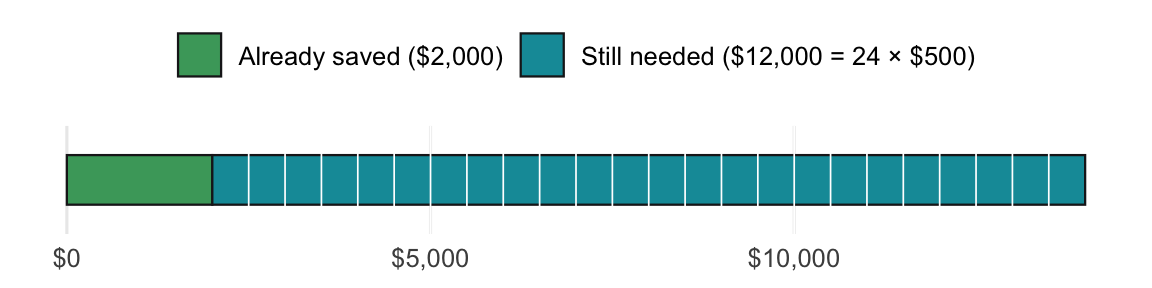
pull(target)Given your current balance and a monthly contribution, how long until you reach the target? Part of the target bar is already filled; the monthly contributions close the gap.
Formula: Months to Goal = (Target − Current Balance) ÷ Monthly Contribution
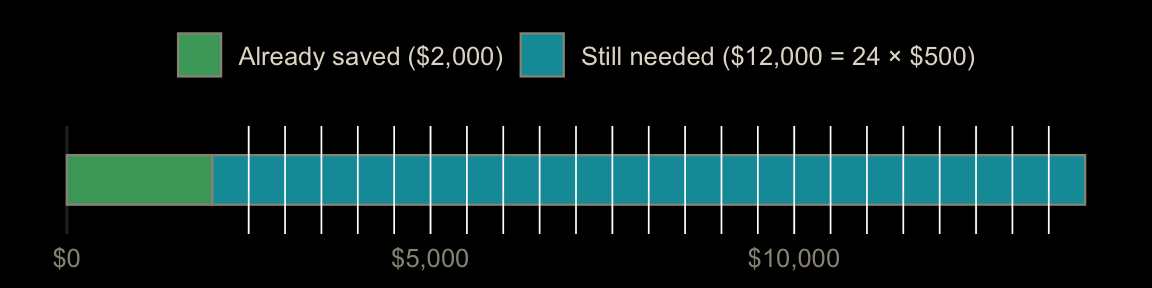
Book example: a $14,000 target with $2,000 saved and $500/month takes (14,000 − 2,000) ÷ 500 = 24 months.
Fill in the blanks to finish months_to_ef_goal(), then find how long it takes to reach $14,000 with $2,000 saved and $500 a month.
Put the target in A2 (14000), the balance in B2 (2000), and the contribution in C2 (500). Find the whole months in D2.
=ROUNDUP(MAX(0, A2 - B2) / C2, 0)This returns 24.
What’s left is the target minus what you already have.
import math
def months_to_ef_goal(target, current_balance, monthly_contribution):
    remaining = max(0, target - current_balance)
    return math.ceil(remaining / monthly_contribution)

months_to_ef_goal(14000, 2000, 500)
What’s left is the target minus what you already have.
months_to_ef_goal <- function(target, current_balance, monthly_contribution) {
  remaining <- max(0, target - current_balance)
  ceiling(remaining / monthly_contribution)
}
months_to_ef_goal(14000, 2000, 500)Double the contribution to $1,000 a month. How many months now?
Change C2 to 1000.
The same formula returns 12. Doubling the contribution halves the wait.
Same target and balance, new contribution.
months_to_ef_goal(14000, 2000, 1000)Same target and balance, new contribution.
months_to_ef_goal(14000, 2000, 1000)You want the $14,000 fund done in 18 months or less, starting from $2,000. Contributions come in $50 steps from $300 to $1,000. What is the smallest one that finishes in time?
Put $300 to $1,000 in steps of 50 in A5:A19, the months for each in B5:B19, and find the smallest contribution that takes 18 months or less.
In B5, filled down: =ROUNDUP((14000-2000)/A5, 0). Then:
=MINIFS(A5:A19, B5:B19, "<=18")The answer is $700 (18 months; $650 takes 19).
Use min(c for c in contributions if months_to_ef_goal(14000, 2000, c) <= 18).
contributions = range(300, 1001, 50)
min(c for c in contributions if months_to_ef_goal(14000, 2000, c) <= 18)
The contribution argument is vectorized, so months_to_ef_goal(14000, 2000, contributions) gives all the months at once. Then min(contributions[...]).
contributions <- seq(300, 1000, by = 50)
months <- months_to_ef_goal(14000, 2000, contributions)
min(contributions[months <= 18])Working backwards: to reach the target by a set month, how much do you need to save each month? The number of slices is fixed, and the question is how wide each slice must be.
Formula: Monthly Contribution = (Target − Current Balance) ÷ Months Remaining
Book example: a $14,000 fund in 18 months with $2,000 saved needs (14,000 − 2,000) ÷ 18 = $667/month.
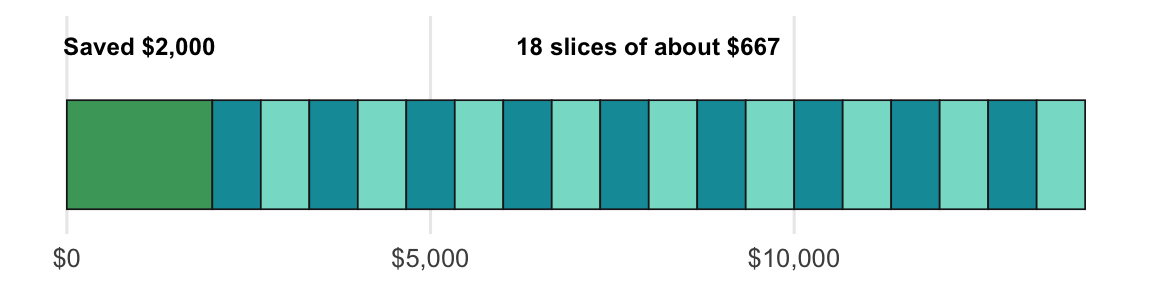
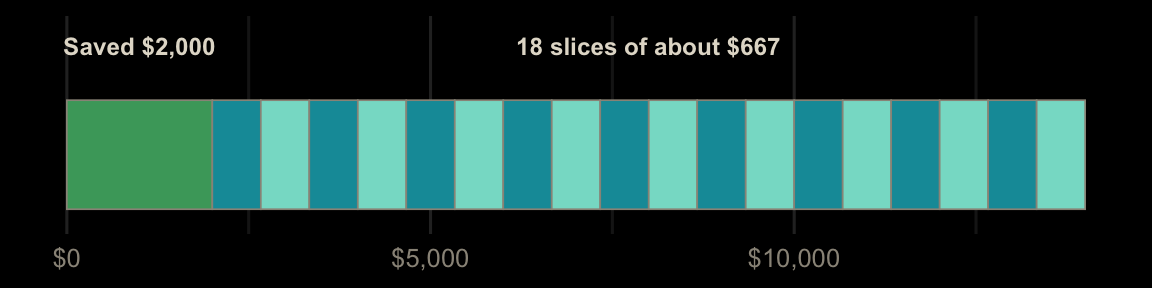
Fill in the blanks to finish monthly_contribution_needed(), then find the monthly amount to build $14,000 in 18 months with $2,000 saved.
Put the target in A2 (14000), the balance in B2 (2000), and the months in C2 (18). Find the monthly amount in D2, rounded up to the dollar.
=ROUNDUP(MAX(0, A2 - B2) / C2, 0)This returns $667.
Split what’s left evenly across the months.
import math
def monthly_contribution_needed(target, current_balance, months):
    remaining = max(0, target - current_balance)
    return math.ceil(remaining / months)

monthly_contribution_needed(14000, 2000, 18)
Split what’s left evenly across the months.
monthly_contribution_needed <- function(target, current_balance, months) {
  remaining <- max(0, target - current_balance)
  ceiling(remaining / months)
}
monthly_contribution_needed(14000, 2000, 18)$667 doesn’t fit the budget. Stretch the deadline to 24 months. What is the monthly amount now?
Change C2 to 24.
The same formula returns $500.
Same target and balance, 24 months.
monthly_contribution_needed(14000, 2000, 24)Same target and balance, 24 months.
monthly_contribution_needed(14000, 2000, 24)The fund sits in a 4.5% high-yield account while you build it, so interest does some of the work. Write contribution_with_interest(target, current_balance, annual_rate, months) and find the monthly amount to reach $14,000 in 18 months from $2,000. The formula is (Target − Balance × (1 + r)^n) × r ÷ ((1 + r)^n − 1), with r = annual rate ÷ 12.
Find the monthly amount in one formula.
=PMT(4.5%/12, 18, -2000, 14000)This returns about $638.17, about $29 a month less than ignoring interest. (Excel shows it as negative because it is money leaving your pocket.)
Set monthly_rate = annual_rate / 12 and growth = (1 + monthly_rate) ** months, then return (target - current_balance * growth) * monthly_rate / (growth - 1).
def contribution_with_interest(target, current_balance, annual_rate, months):
    monthly_rate = annual_rate / 12
    growth = (1 + monthly_rate) ** months
    return (target - current_balance * growth) * monthly_rate / (growth - 1)

contribution_with_interest(14000, 2000, 0.045, 18)
Set monthly_rate <- annual_rate / 12 and growth <- (1 + monthly_rate)^months, then return (target - current_balance * growth) * monthly_rate / (growth - 1).
contribution_with_interest <- function(target, current_balance, annual_rate, months) {
  monthly_rate <- annual_rate / 12
  growth <- (1 + monthly_rate)^months
  (target - current_balance * growth) * monthly_rate / (growth - 1)
}
contribution_with_interest(14000, 2000, 0.045, 18)A fund in a high-yield savings account earns interest. It will not change your timeline much, but it is real money. Each month the balance is multiplied by (1 + the monthly rate).
Formula: Future Value = Balance × (1 + monthly rate)^months, where monthly rate = annual rate ÷ 12
Book example: $14,000 at 4.5%, untouched for 12 months, grows to about $14,643.
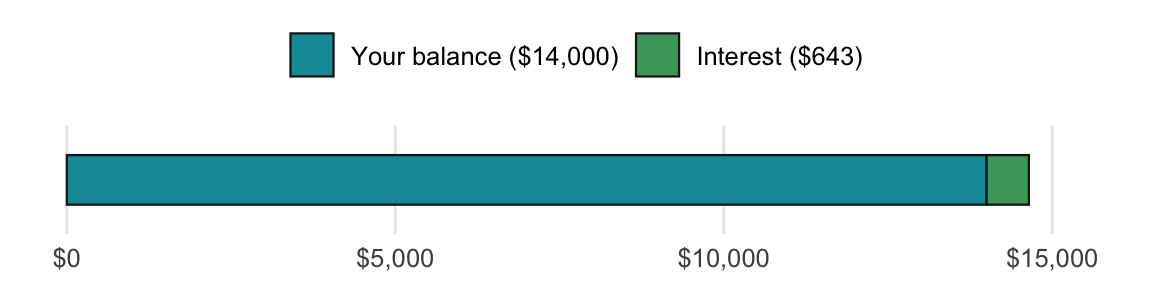
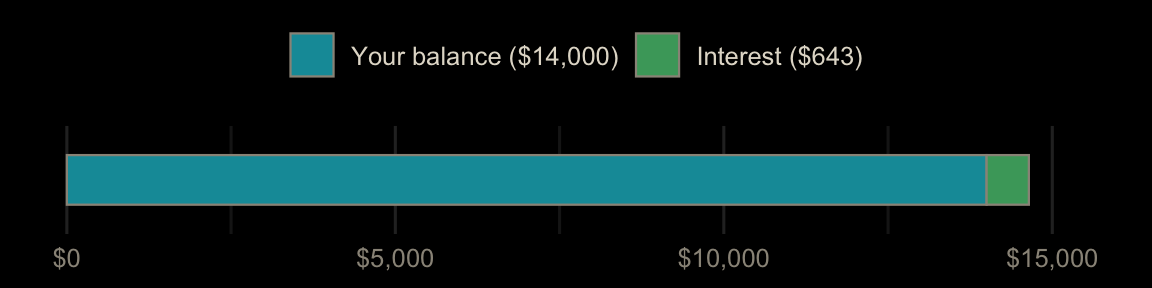
Fill in the blanks to finish ef_growth(), then find what $14,000 grows to in 12 months at 4.5%.
Put the balance in A2 (14000), the rate in B2 (0.045), and months in C2 (12). Find the balance in D2.
=A2*(1+B2/12)^C2This returns $14,643.16.
Split the yearly rate across 12 months, then compound once per month.
def ef_growth(balance, annual_rate, months):
    monthly_rate = annual_rate / 12
    return balance * (1 + monthly_rate) ** months

ef_growth(14000, 0.045, 12)
Split the yearly rate across 12 months, then compound once per month.
ef_growth <- function(balance, annual_rate, months) {
  monthly_rate <- annual_rate / 12
  balance * (1 + monthly_rate)^months
}
ef_growth(14000, 0.045, 12)A big bank savings account pays 0.01%. Over 12 months, how much more interest does the 4.5% high-yield account earn on $14,000?
Find both interest amounts and the difference.
=(14000*(1+4.5%/12)^12 - 14000) - (14000*(1+0.01%/12)^12 - 14000)This returns about $641.76. The big bank pays about $1.40.
Write 0.01% as 0.0001.
hysa = ef_growth(14000, 0.045, 12) - 14000
big_bank = ef_growth(14000, 0.0001, 12) - 14000
hysa - big_bank
Write 0.01% as 0.0001.
hysa <- ef_growth(14000, 0.045, 12) - 14000
big_bank <- ef_growth(14000, 0.0001, 12) - 14000
hysa - big_bankA surprise $300 car repair is coming. At 4.5%, after how many whole months has the $14,000 fund earned at least $300 of interest?
Put months 1 to 24 in A5:A28, find the interest at each month in B, then find the first month at or above $300.
In B5, filled down: =14000*(1+4.5%/12)^A5 - 14000. Then:
=MATCH(TRUE, B5:B28>=300, 0)The answer is 6 months.
Use while ef_growth(14000, 0.045, months) - 14000 < 300: and add 1 to months inside the loop.
months = 1
while ef_growth(14000, 0.045, months) - 14000 < 300:
    months += 1

months
ef_growth() is vectorized: pass all 24 months, subtract 14000, and use min(months[...]).
months <- 1:24
interest <- ef_growth(14000, 0.045, months) - 14000
min(months[interest >= 300])