Each topic starts with a real scenario and a bar model, then three levels of exercises. Level 1 (Guided) fills in the blanks of a finished function. Level 2 (Practice) applies it to new numbers. Level 3 (Challenge) asks a new question with little scaffolding. The R and Python exercises run in your browser: click Run Code to try, Submit Answer to check, and use the hint or solution if you get stuck. Excel exercises have a solution you can reveal.
Your estate starts with your net worth: everything you own minus everything you owe.
Formula: Net worth = Total assets − Total debts
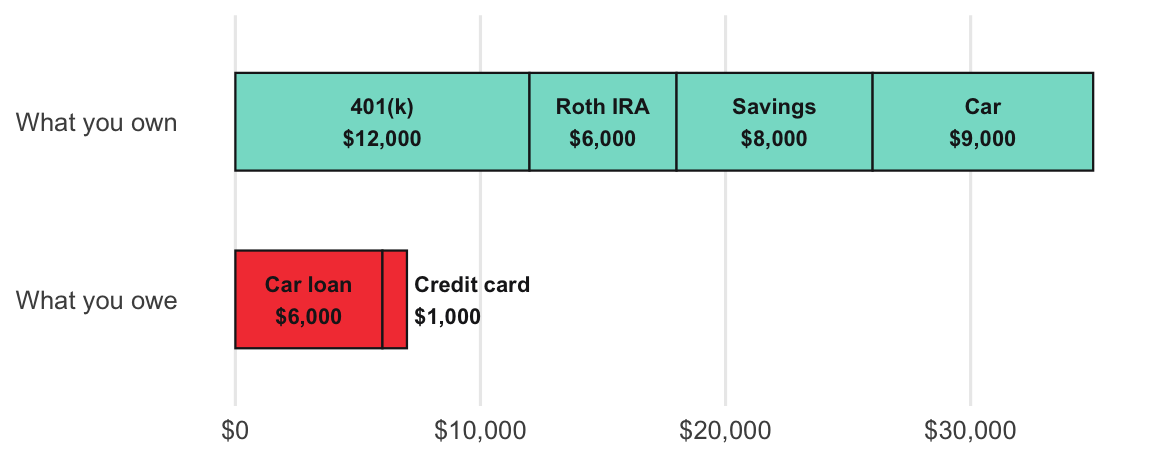
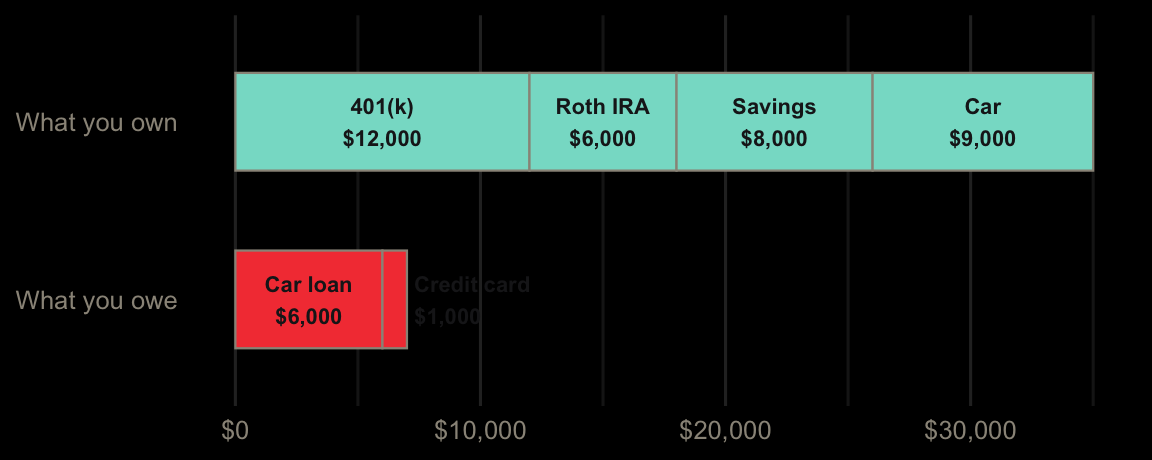
Example: ($12,000 + $6,000 + $8,000 + $9,000) − ($6,000 + $1,000) = $35,000 − $7,000 = a net worth of $28,000.
How to read this result: net worth is the yearly check in on your progress. It’s also roughly what your estate would be worth today, before adding any life insurance.
Fill in the blanks to finish net_worth(), then find the net worth for assets of $12,000 (401(k)), $6,000 (Roth IRA), $8,000 (savings), and $9,000 (car), with debts of $6,000 (car loan) and $1,000 (credit card).
Put the assets in B2:B5 and the debts in B7:B8. Find net worth in B10.
=SUM(B2:B5) - SUM(B7:B8)This returns $28,000.
Add up everything you own, then everything you owe.
def net_worth(assets, debts):
    return sum(assets) - sum(debts)

net_worth([12000, 6000, 8000, 9000], [6000, 1000])
Add up everything you own, then everything you owe.
net_worth <- function(assets, debts) {
  sum(assets) - sum(debts)
}
net_worth(c(12000, 6000, 8000, 9000), c(6000, 1000))A recent graduate has $3,000 in savings, a $5,000 car, and $30,000 of student loans. What is their net worth?
Put the new numbers in the sheet.
The same formula returns -$22,000. A negative start is common, not a failure.
Assets are [3000, 5000]; debts are [30000].
net_worth([3000, 5000], [30000])Assets are c(3000, 5000); debts are 30000.
net_worth(c(3000, 5000), 30000)Track net worth over a year. Using the balance sheet below, how much did net worth grow from last year to this year?
| Item | Type | Last year | This year |
|---|---|---|---|
| 401(k) | Asset | $12,000 | $15,500 |
| Roth IRA | Asset | $6,000 | $8,000 |
| Savings | Asset | $8,000 | $9,500 |
| Car | Asset | $9,000 | $7,500 |
| Car loan | Debt | $6,000 | $3,800 |
| Credit card | Debt | $1,000 | $0 |
Put the table in A1:D7. Find net worth for each year with SUMIF(), then the change.
=(SUMIF(B2:B7,"Asset",D2:D7)-SUMIF(B2:B7,"Debt",D2:D7)) - (SUMIF(B2:B7,"Asset",C2:C7)-SUMIF(B2:B7,"Debt",C2:C7))Net worth went from $28,000 to $36,700, a gain of $8,700, even though the car lost $1,500 of value.
Give debts a sign of -1: sign = sheet["type"].map({"Asset": 1, "Debt": -1}). Then (sheet["this_year"] * sign).sum() is this year’s net worth.
sign = sheet["type"].map({"Asset": 1, "Debt": -1})
(sheet["this_year"] * sign).sum() - (sheet["last_year"] * sign).sum()
mutate(sign = if_else(type == "Debt", -1, 1)), then summarise(change = sum(this_year * sign) - sum(last_year * sign)).
sheet |>
  mutate(sign = if_else(type == "Debt", -1, 1)) |>
  summarise(change = sum(this_year * sign) - sum(last_year * sign)) |>
pull(change)Life insurance isn’t part of net worth while you’re alive, but it pays out when you die. Add it, then split the estate by what decides who gets each piece.
Formula: Share controlled by beneficiary forms = Assets with a named beneficiary ÷ Total estate
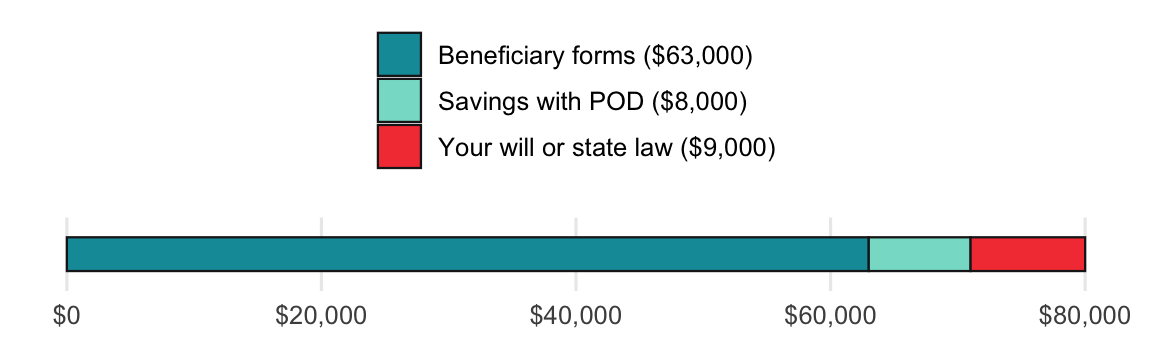
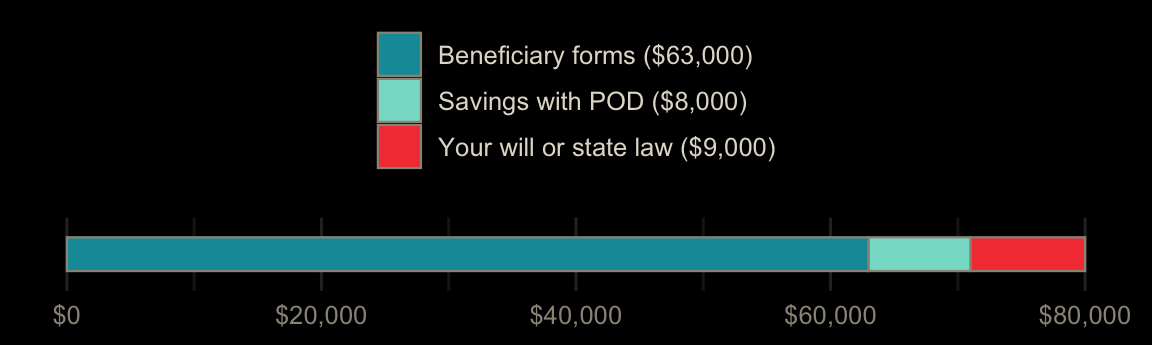
Example: ($12,000 + $6,000 + $45,000 + $8,000) ÷ $80,000 = about 89% of the estate, decided by forms that take minutes to fill out. That’s why beneficiary designations come before a will for most young people.
How to read this result: the higher the share, the less your will has to do. With every form filled in, a will only decides the car. With no forms, all $80,000 goes through probate.
Fill in the blanks to finish beneficiary_share(), then find the share of an $80,000 estate controlled by beneficiary forms when the 401(k) ($12,000), Roth IRA ($6,000), life insurance ($45,000), and savings ($8,000) all have forms, and the $9,000 car does not. Give a decimal.
Put the amounts in B2:B6 and “Yes”/“No” for has a form in C2:C6. Find the share.
=SUMIF(C2:C6, "Yes", B2:B6) / SUM(B2:B6)This returns 0.8875, about 89% of the estate.
The bottom of the fraction is the whole estate: both piles together.
def beneficiary_share(with_beneficiary, without_beneficiary):
    return sum(with_beneficiary) / (sum(with_beneficiary) + sum(without_beneficiary))

beneficiary_share([12000, 6000, 45000, 8000], [9000])
The bottom of the fraction is the whole estate: both piles together.
beneficiary_share <- function(with_beneficiary, without_beneficiary) {
  sum(with_beneficiary) / (sum(with_beneficiary) + sum(without_beneficiary))
}
beneficiary_share(c(12000, 6000, 45000, 8000), 9000)You never added a payable-on-death (POD) designation to the $8,000 savings account. What share do the forms control now?
Change savings to “No”.
The same formula returns 0.7875. The $8,000 now goes through a will or state law.
Move the 8000 from the first list to the second.
beneficiary_share([12000, 6000, 45000], [8000, 9000])Move the 8000 from the first vector to the second.
beneficiary_share(c(12000, 6000, 45000), c(8000, 9000))Worst case: only the 401(k) has a beneficiary form. How many dollars of the estate would pass through a will (or state law, if there’s no will)?
Mark only the 401(k) “Yes” and total the rest.
=SUMIF(C2:C6, "No", B2:B6)This returns $68,000, including the $45,000 life insurance payout.
estate["has_form"] = estate["account"] == "401(k)", then sum amount where has_form is False (use ~).
estate["has_form"] = estate["account"] == "401(k)"
estate.loc[~estate["has_form"], "amount"].sum()
mutate(has_form = account == "401(k)"), then filter(!has_form) and summarise(total = sum(amount)).
estate |>
  mutate(has_form = account == "401(k)") |>
  filter(!has_form) |>
  summarise(total = sum(amount)) |>
  pull(total)