---
title: "Penguins EDA"
format:
  html:
    code-fold: true
---

## Penguin Size and Mass by Sex and Species

```{r}
library(palmerpenguins)
library(dplyr)
library(ggplot2)

df <- palmerpenguins::penguins
```

```{r}
df %>%
  group_by(species, sex) %>%
  summarise(
    across(
      where(is.numeric),
      \(x) mean(x, na.rm = TRUE)
      )
    ) %>%
  knitr::kable()
```

## Penguin Size vs Mass by Species

```{r}
df %>%
  ggplot(aes(x = bill_length_mm, y = body_mass_g, color = species)) +
  geom_point() +
  geom_smooth(method = "lm")
```EDA in R
The eda-basic.qmd file groups the penguins by species and sex, summarizes the means of the numeric columns, and plots bill length against body mass.
Expand the section below to view the source file:
View eda-basic.qmd
I’ve also included the code from the eda-basic.qmd file in the sections below.
Load data
The code below loads palmerpenguins, dplyr, and ggplot2 and stores the penguins data as df:
library(palmerpenguins)
library(dplyr)
library(ggplot2)

df <- palmerpenguins::penguins
Manipulate and summarize
The pipeline below returns a table with the mean of every numeric column by species and sex:
df %>%
  dplyr::group_by(species, sex) %>%
  dplyr::summarise(
    dplyr::across(
      dplyr::where(is.numeric),
      \(x) mean(x, na.rm = TRUE)
      )
    ) %>%
knitr::kable()| species | sex | bill_length_mm | bill_depth_mm | flipper_length_mm | body_mass_g | year |
|---|---|---|---|---|---|---|
| Adelie | female | 37.25753 | 17.62192 | 187.7945 | 3368.836 | 2008.055 |
| Adelie | male | 40.39041 | 19.07260 | 192.4110 | 4043.493 | 2008.055 |
| Adelie | NA | 37.84000 | 18.32000 | 185.6000 | 3540.000 | 2007.000 |
| Chinstrap | female | 46.57353 | 17.58824 | 191.7353 | 3527.206 | 2007.971 |
| Chinstrap | male | 51.09412 | 19.25294 | 199.9118 | 3938.971 | 2007.971 |
| Gentoo | female | 45.56379 | 14.23793 | 212.7069 | 4679.741 | 2008.069 |
| Gentoo | male | 49.47377 | 15.71803 | 221.5410 | 5484.836 | 2008.066 |
| Gentoo | NA | 45.62500 | 14.55000 | 215.7500 | 4587.500 | 2008.400 |
Visualize
The scatter plot below shows bill length against body mass, with a linear fit line for each species:
df %>%
  ggplot2::ggplot(
    ggplot2::aes(
      x = bill_length_mm,
      y = body_mass_g,
      color = species)) +
  ggplot2::geom_point() +
  ggplot2::geom_smooth(method = "lm")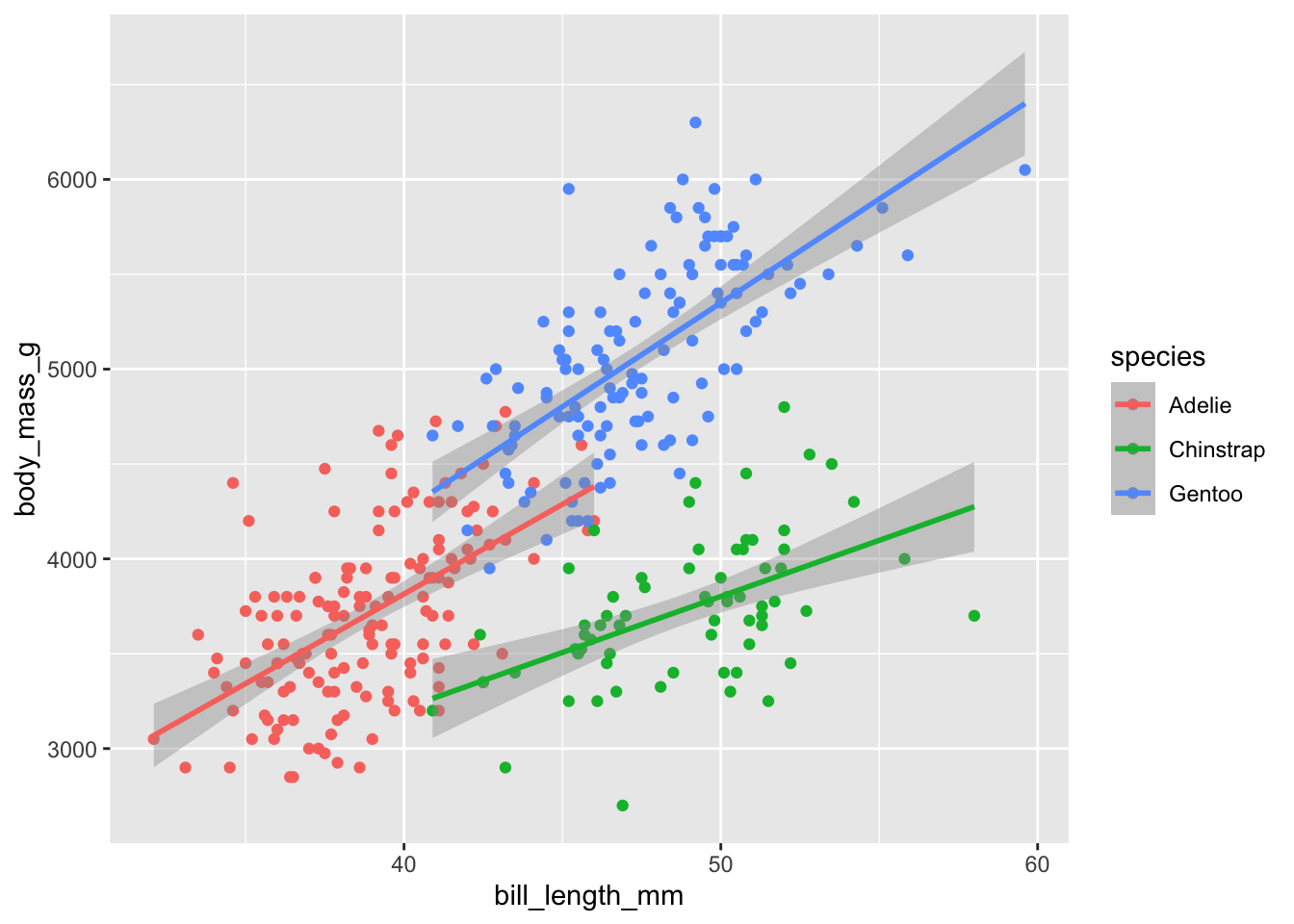
Recap
The
eda-basic.qmdfile loadspalmerpenguins::penguins, groups the data byspeciesandsex, and usesdplyr::across()withwhere(is.numeric)to compute the mean of every numeric column.The scatter plot of
bill_length_mmagainstbody_mass_gadds ageom_smooth(method = "lm")line for each species. That linear relationship is what the model in Modeling in Python estimates: body mass increases with bill length, and species shifts the baseline.
Next, Lab 2: Project Architecture loads the penguins data into duckdb and turns the model into a vetiver API.