7 Box plots
TipTheme:
theme_n64()
Graphs in this chapter use fmggp2::theme_n64(), modeled on the Nintendo 64: controller gray background, charcoal frame, the red, green, blue, and yellow logo colors, and an Arial Black title.
7.1 Description
Box plots use five values to summarize data: minimum, first quartile, median, third quartile, and maximum. The plot looks like a box with a line in the middle. Whiskers go from the box to the smallest and largest values that aren’t unusual. Unusual points are shown as dots outside the whiskers. Box plots help identify unusual points and compare different groups of data.
7.2 Set up
PACKAGES:
Install packages.
show/hide
library(ggplot2)
library(dplyr) # for tibble() and data manipulation
DATA:
Most Mario Kart 64 laps on Luigi Raceway take about the same time. Every so often, though, a player nails a mushroom boost (a very fast lap) or gets hit by a blue shell (a very slow one). We’ll simulate 200 lap times with rt(), which draws from a distribution with more extreme values than the normal. Setting the seed with set.seed() means you’ll get the same 200 laps every time you run the code below.
show/hide
set.seed(64) # same 200 laps every time the code runs
mario_kart_laps <- tibble(
  lap_id = 1:200, # 200 different laps, one row each
  seconds = round(
    45 + 2 * rt(n = 200, df = 3), # lap times centered at 45 seconds (heavy tails create outliers)
    2 # two decimal places
    )
)
glimpse(mario_kart_laps)
#> Rows: 200
#> Columns: 2
#> $ lap_id  <int> 1, 2, 3, 4, 5, 6, 7, 8, 9, 10, 1…
#> $ seconds <dbl> 42.88, 47.11, 44.55, 47.41, 38.7…
7.3 Distribution
A box plot doesn’t draw every value. It draws five summary numbers and then flags the values that are unusually far from the middle. That makes it a good tool for data with extreme values, as long as you know how those five numbers and the outlier rule work. Below we’ll move from the lap times, to a picture, to the formula.
COUNT IT:
Start with the first ten laps.
show/hide
head(mario_kart_laps$seconds, 10)
#>  [1] 42.88 47.11 44.55 47.41 38.71 44.51 44.63
#>  [8] 44.23 46.00 48.25
Most of these laps take between 42 and 49 seconds, but one (38.71) is much faster than the rest. The numbers behind a box plot are the quartiles: the 25th percentile (Q1), the median, and the 75th percentile (Q3). The distance between Q1 and Q3 is the interquartile range (IQR). Any value more than 1.5 IQRs past Q1 or Q3 (the “fences”) is drawn as an outlier.
show/hide
lap_stats <- mario_kart_laps |>
  summarise(
    q1 = quantile(seconds, 0.25),
    median = median(seconds),
    q3 = quantile(seconds, 0.75),
    iqr = IQR(seconds),
    lower_fence = q1 - 1.5 * iqr,
    upper_fence = q3 + 1.5 * iqr,
    outliers = sum(seconds < lower_fence | seconds > upper_fence))
lap_stats
Half of all laps fall inside a window only 3.2 seconds wide, yet 7 laps land outside the fences. The lap at 38.71 seconds from the first ten is one of them: it’s just below the lower fence.
DRAW IT:
The box plot below labels each of those numbers. The box runs from Q1 to Q3, the line inside it is the median, the whiskers stop at the last lap inside the fences, and every lap past a fence is drawn as a point.
show/hide
box_labels <- tibble(
  y = c(lap_stats$q1, lap_stats$median, lap_stats$q3,
        lap_stats$lower_fence, lap_stats$upper_fence),
  label = c("Q1", "Median", "Q3", "Lower fence", "Upper fence"),
  vjust = c(0.5, 0.5, 0.5, -0.5, -0.5))

ggplot(data = mario_kart_laps, aes(x = "", y = seconds)) +
  geom_boxplot(width = 0.4) +
  geom_hline(yintercept = c(lap_stats$lower_fence, lap_stats$upper_fence),
    linetype = "dashed", color = "#E4000F") +
  geom_text(data = box_labels,
    aes(x = 1.25, y = y, vjust = vjust,
        label = paste0(label, " (", round(y, 1), ")")),
    hjust = 0, size = 3.5) +
  labs(x = NULL, y = "Lap time (seconds)")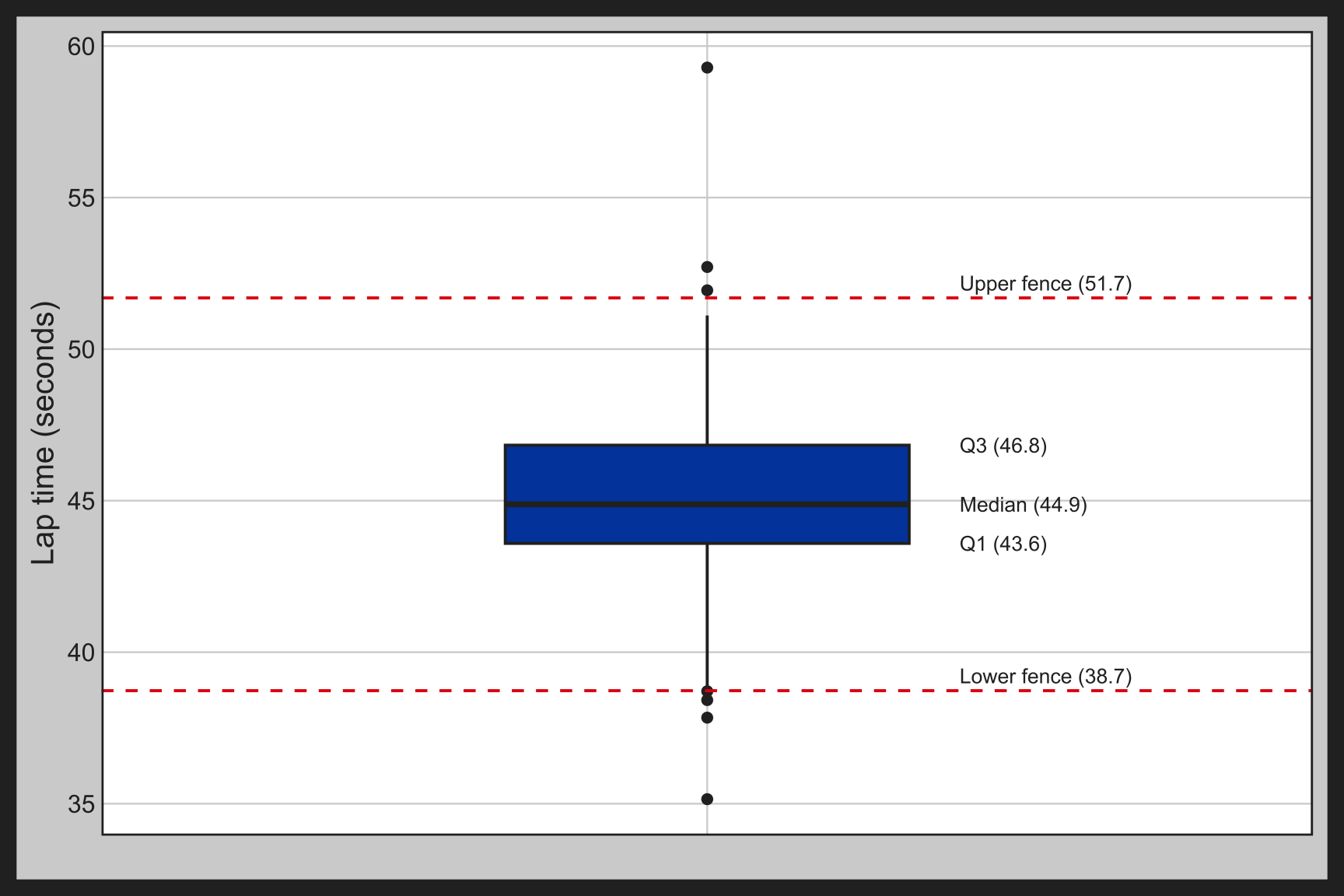
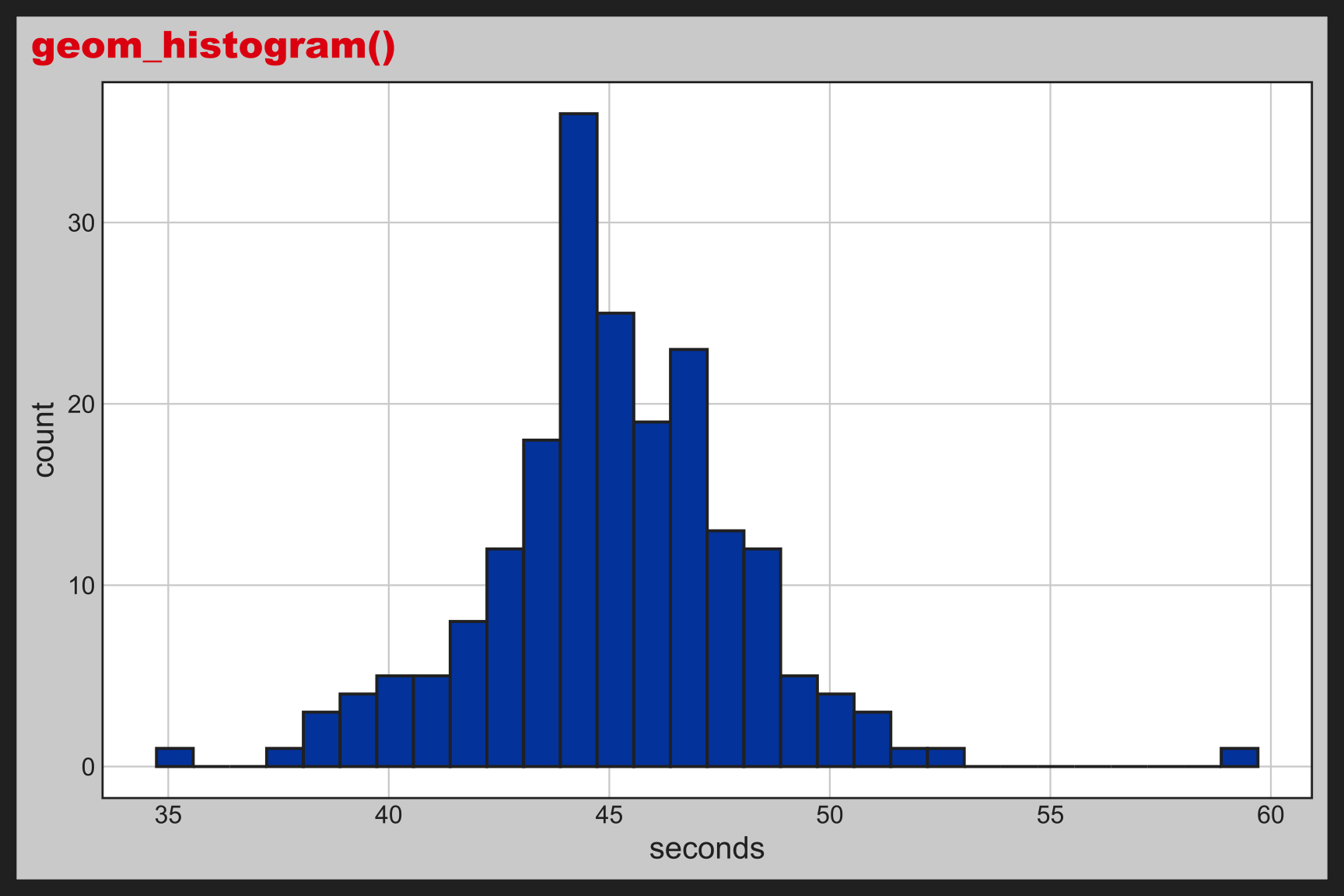
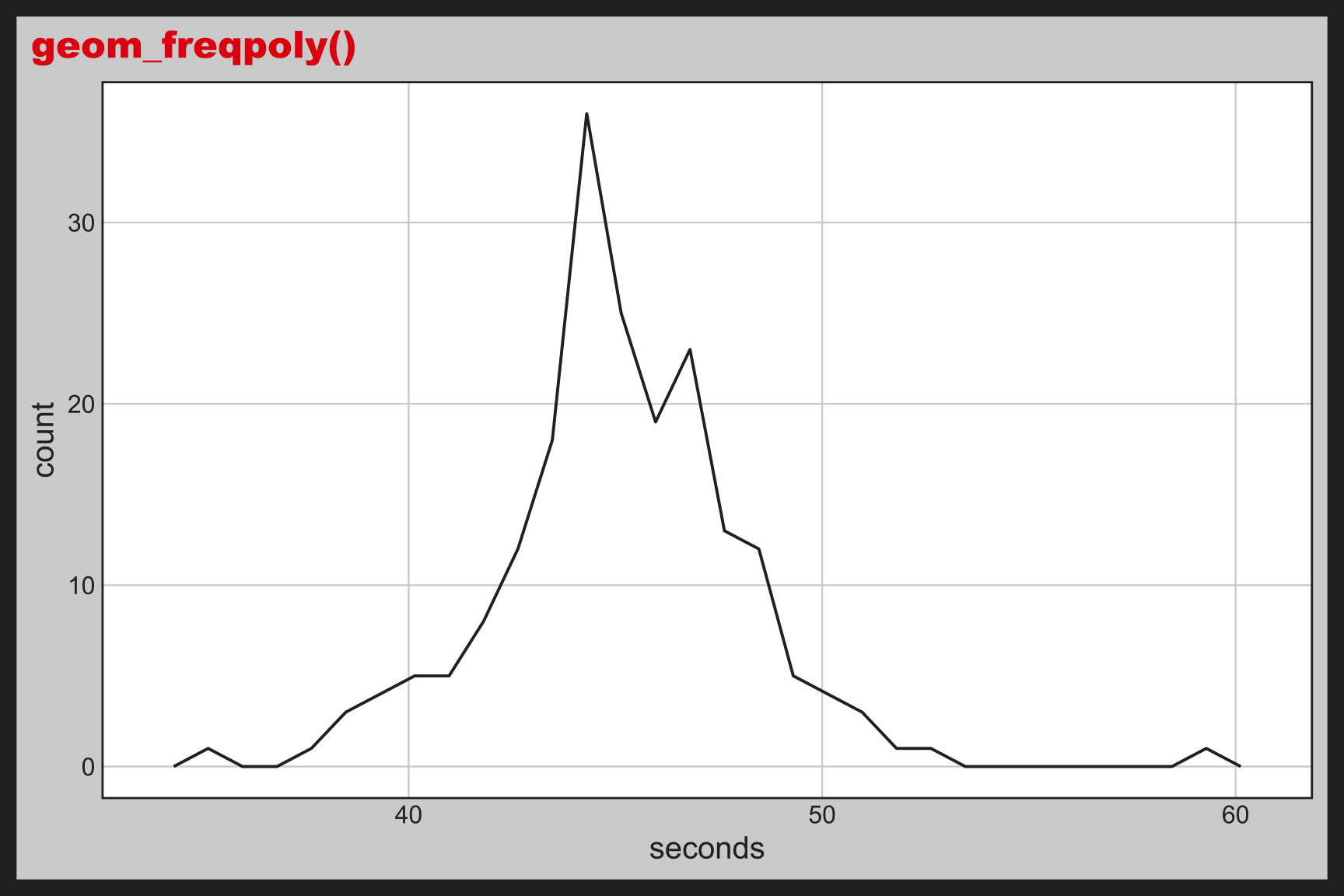
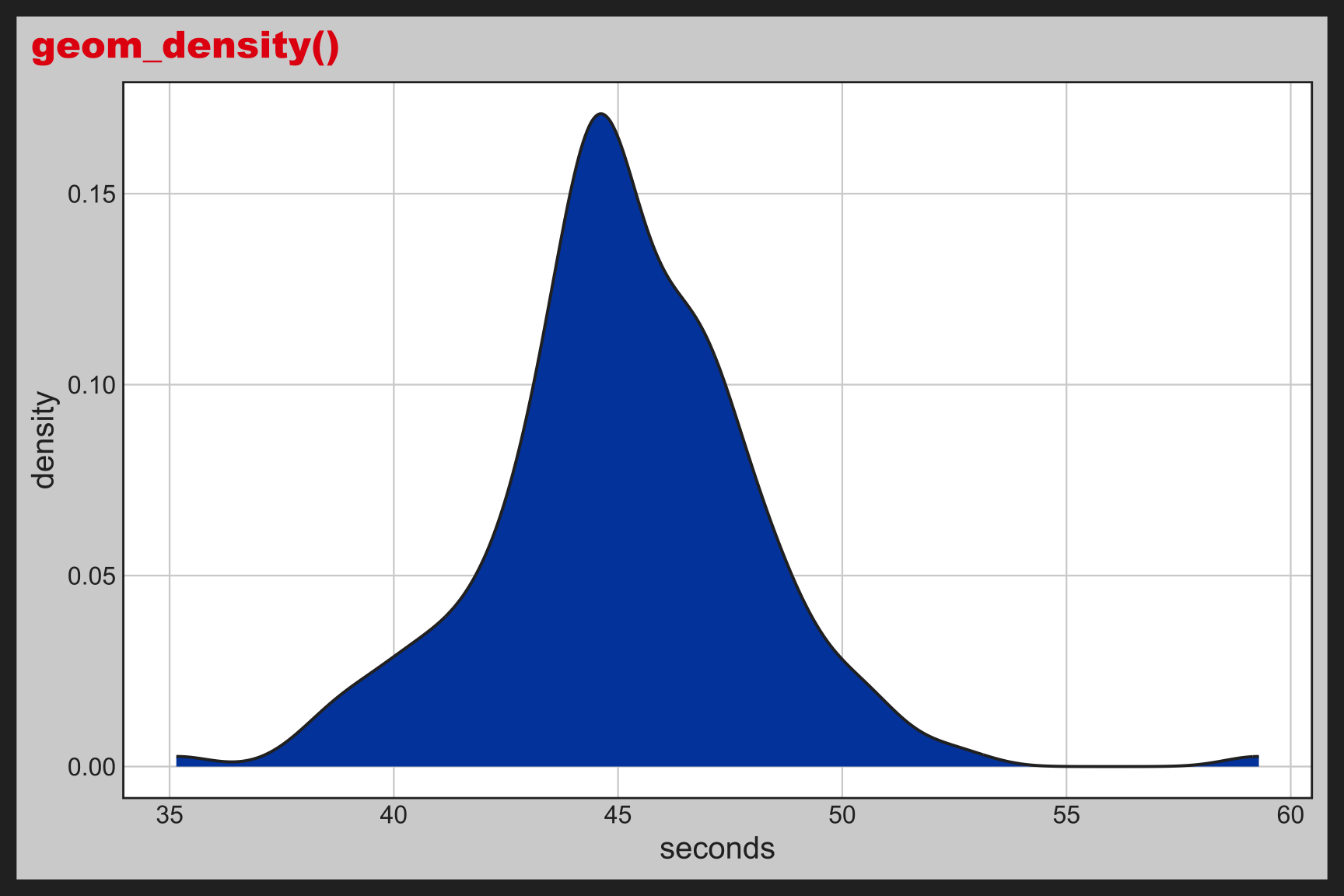
A box plot hides the shape between the five numbers. The plots below show the same 200 laps four other ways. Every one puts most laps near 45 seconds, with a few scattered far out on both sides. The last three also show a single peak.
show/hide
ggplot(mario_kart_laps, aes(x = seconds, y = "")) +
  geom_jitter(height = 0.2) +
  labs(title = "geom_jitter()", y = NULL)

ggplot(mario_kart_laps, aes(x = seconds)) +
  geom_histogram(bins = 30) +
  labs(title = "geom_histogram()")

ggplot(mario_kart_laps, aes(x = seconds)) +
  geom_freqpoly(bins = 30) +
  labs(title = "geom_freqpoly()")

ggplot(mario_kart_laps, aes(x = seconds)) +
  geom_density() +
  labs(title = "geom_density()")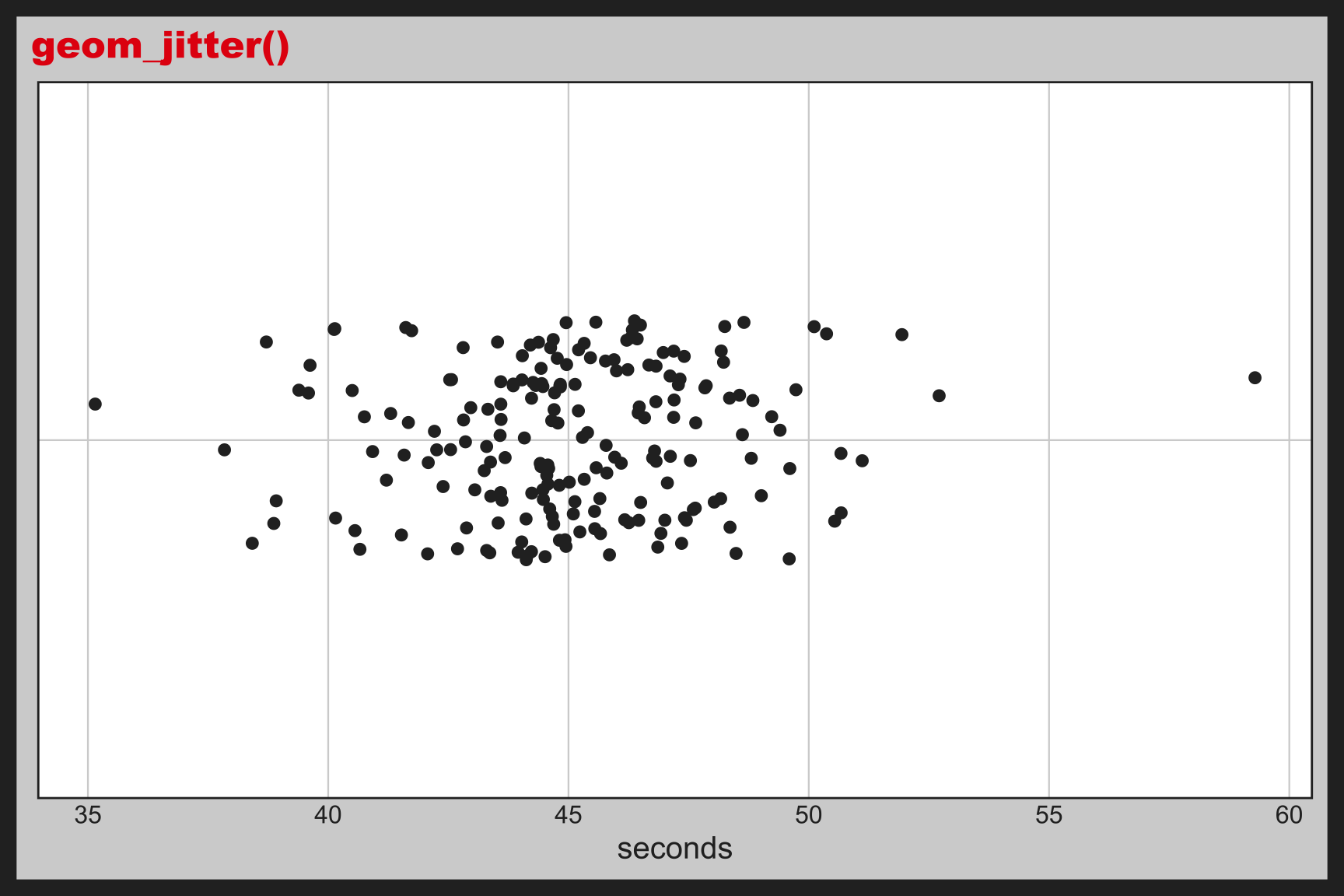
NAME IT:
The rt() call draws from Student’s t distribution, which is then stretched and shifted into lap times:
\[ X = 45 + 2T, \quad T \sim t(\nu = 3) \]
The 45 sets the center (the median lap) and the 2 sets the spread. The degrees of freedom (\(\nu\)) control the tails: a small \(\nu\) like 3 gives “heavy” tails with more extreme values than a normal distribution, and as \(\nu\) grows the t distribution turns into the normal.
The outlier rule shows the difference. For a normal distribution, only about 0.7% of values land past the fences, so we’d expect about 1 outlier in 200 laps. For a t distribution with 3 degrees of freedom, about 5.5% land past the fences, or about 11 laps in 200. We got 7.
Try df = 30 in rt(). We’d expect only about 2 outliers in 200 laps, but this seed still gives 6. A single sample of 200 laps can land far from what we expect.
7.4 Grammar
CODE:
Create labels with labs()
- Assign a blank character string (
"") to thexaxis inlabs()
Initialize the graph with ggplot() and provide data
Map seconds to the y axis and an empty string ("") to the x axis
Add the geom_boxplot() layer
show/hide
labs_boxplot <- labs(
  title = "Mario Kart 64",
  caption = "Simulated data",
  subtitle = "200 lap times on Luigi Raceway",
  x = "",
  y = "Lap time (seconds)")
ggp2_boxplot <- ggplot(data = mario_kart_laps,
           aes(x = "",
               y = seconds)) +
        geom_boxplot()
ggp2_boxplot +
  labs_boxplot
GRAPH: